This couldn't be a self respecting Antarctic web site without an entry on penguins and seals. These two kinds of animals are the most conspicuous and well known residents of Antarctica. Whales are another well known type of animal, but their numbers have been so decimated by whaling in the early part of this century that I only saw whales on three separate occasions.Birds and Seals of Antarctica
by David Krakowski and Isidro Bosch
Penguins are flightless birds are adapted to a life at sea. Their wings are used as flippers, and their bodies are designed to move easily underwater. They look quite clumsy on land, however, and watching the never-ending bustle of a nesting colony
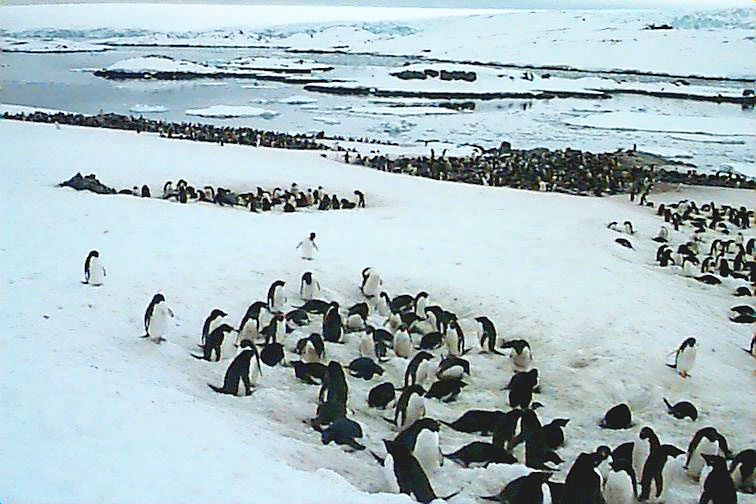 can
be likened to watching a real-life cartoon. Despite their apparently
ungainly appearance on land, penguins seem to have no problem negotiating
the most prohibitive terrain. They can come ashore at a wave
swept rocky beach and come out of the water unscathed. I have seen
penguins nesting on cliff sides, and I have seen penguins climbing hills
that I could barely scramble up. There is no doubt about a penguin's
grace in water. The penguin has been labeled as a "flightless" bird;
whoever made that description could not have ever observed penguins underwater.
Their fluid motion is awe-inspiring, they appear to dance with each other
in the water. They "porpoise" at the surface in groups, like so many
flying fish. Dr. Bosch has had the unique pleasure of swimming, both
SCUBA and snorkel with these animals.
can
be likened to watching a real-life cartoon. Despite their apparently
ungainly appearance on land, penguins seem to have no problem negotiating
the most prohibitive terrain. They can come ashore at a wave
swept rocky beach and come out of the water unscathed. I have seen
penguins nesting on cliff sides, and I have seen penguins climbing hills
that I could barely scramble up. There is no doubt about a penguin's
grace in water. The penguin has been labeled as a "flightless" bird;
whoever made that description could not have ever observed penguins underwater.
Their fluid motion is awe-inspiring, they appear to dance with each other
in the water. They "porpoise" at the surface in groups, like so many
flying fish. Dr. Bosch has had the unique pleasure of swimming, both
SCUBA and snorkel with these animals.
There are a number of species of penguins, each unique in appearance and/or
habits. Perhaps the most well known penguin is the emperor penguin.
The males of this species are renowned for their dedication to their young,
standing on the frozen ocean for three months during the brutal Antarctic
winter, without food, tending to a single egg that it holds on the top
of its feet tucked away under a fold of skin. 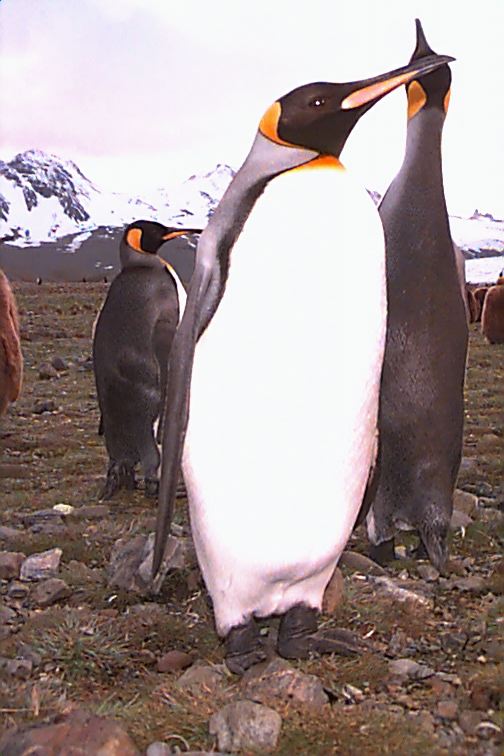 The
female comes from the sea after three months, walking up to a hundred miles
over the sea ice to relieve her mate of his duties. The emperor penguin
is the largest penguin, and, by some accounts, the most graceful and regal.
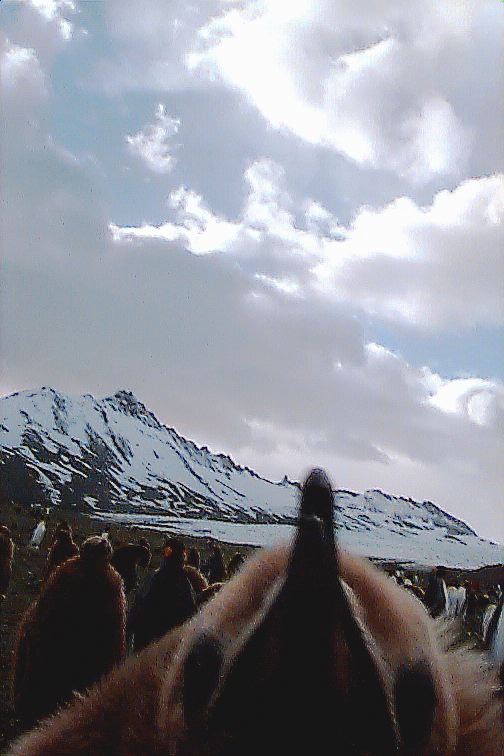
Its relative, the king penguin (image 2), is only
slightly smaller, and resides in the northernmost reaches of the Antarctic
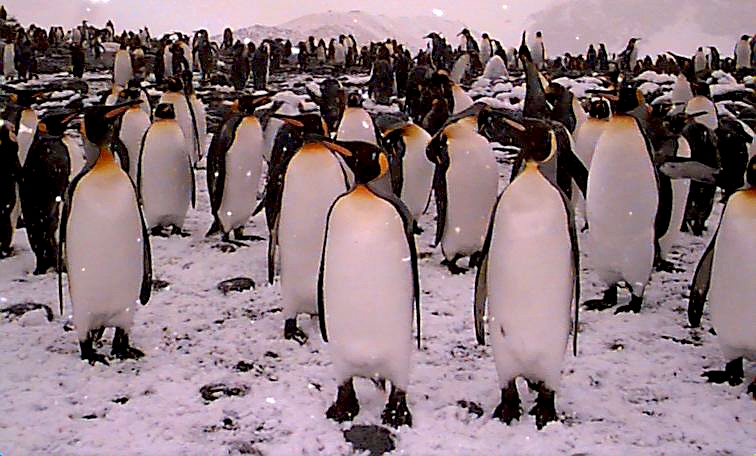
and Sub-Antarctic. I had the unique chance to visit a king penguin
rookery on South Georgia Island (image 3), when
the chicks were being left by their parents to fend for themselves.
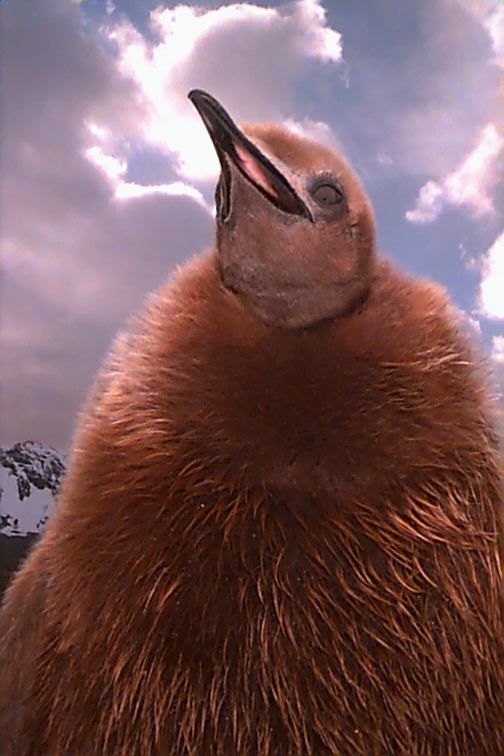
By this time the chicks were as large as their parents, and some were beginning
to shed the thick brown coat of down (image 4),
revealing adult plumage beneath. But these chicks did not want to
grow up. They still whistled like babies, begging any adult that
happened by for a regurgitated meal of krill and squid. In fact,
some were so desperate for attention that they would come right up to us,
asking us in baby king penguin language for a quick meal (image
5).
The
female comes from the sea after three months, walking up to a hundred miles
over the sea ice to relieve her mate of his duties. The emperor penguin
is the largest penguin, and, by some accounts, the most graceful and regal.
Its relative, the king penguin (image 2), is only
slightly smaller, and resides in the northernmost reaches of the Antarctic
and Sub-Antarctic. I had the unique chance to visit a king penguin
rookery on South Georgia Island (image 3), when
the chicks were being left by their parents to fend for themselves.
By this time the chicks were as large as their parents, and some were beginning
to shed the thick brown coat of down (image 4),
revealing adult plumage beneath. But these chicks did not want to
grow up. They still whistled like babies, begging any adult that
happened by for a regurgitated meal of krill and squid. In fact,
some were so desperate for attention that they would come right up to us,
asking us in baby king penguin language for a quick meal (image
5).
Most of the penguins we saw on and around Palmer Station were Adelie
penguins. These small penguins are the prototypical tuxedo waddling
little birds (image 6)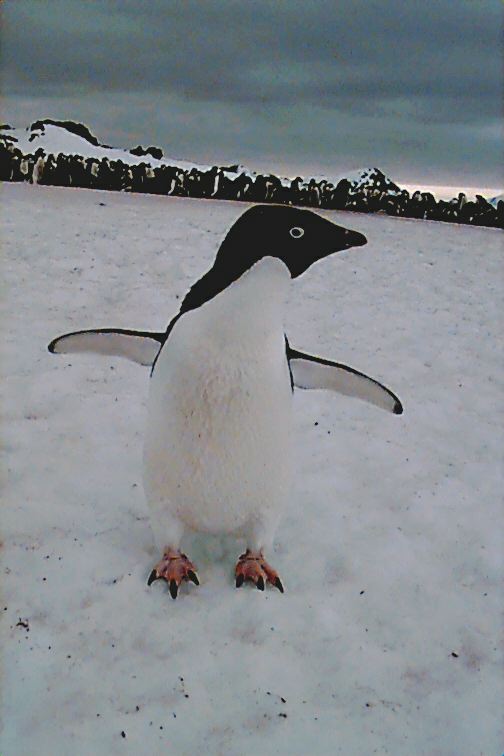 .
They are curious, and will come right up to humans in some cases.
In general, most Antarctic animals don't show fear of man, as they have
evolved without land predators. So it is possible to walk through
a penguin colony without disturbing the animals greatly. Without
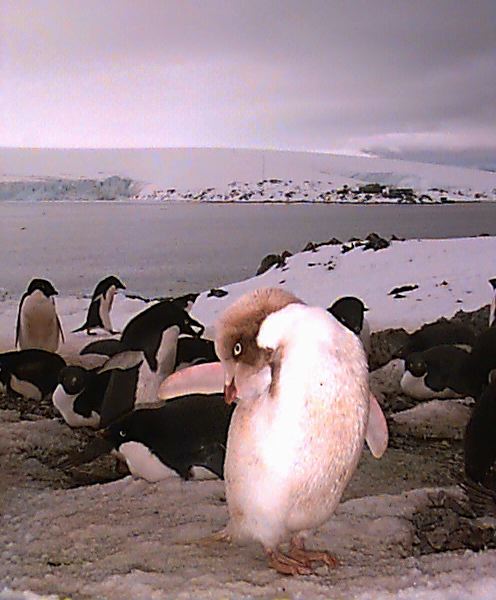
a doubt the loveliest but most unusual penguin we saw was an adelie female
that people have nicknamed “blondie” for obvious
reasons. She’s one in a thousand and a favorite among scientists
and tourists.
.
They are curious, and will come right up to humans in some cases.
In general, most Antarctic animals don't show fear of man, as they have
evolved without land predators. So it is possible to walk through
a penguin colony without disturbing the animals greatly. Without
a doubt the loveliest but most unusual penguin we saw was an adelie female
that people have nicknamed “blondie” for obvious
reasons. She’s one in a thousand and a favorite among scientists
and tourists.
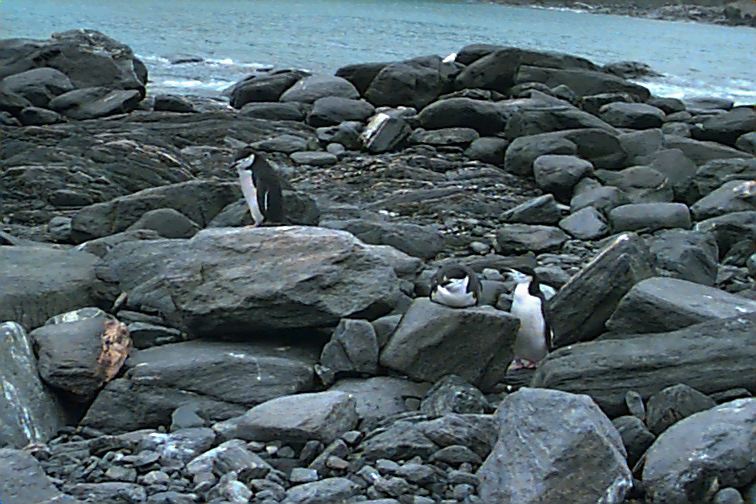
Related to the Adelie penguins are the chinstrap penguins (image
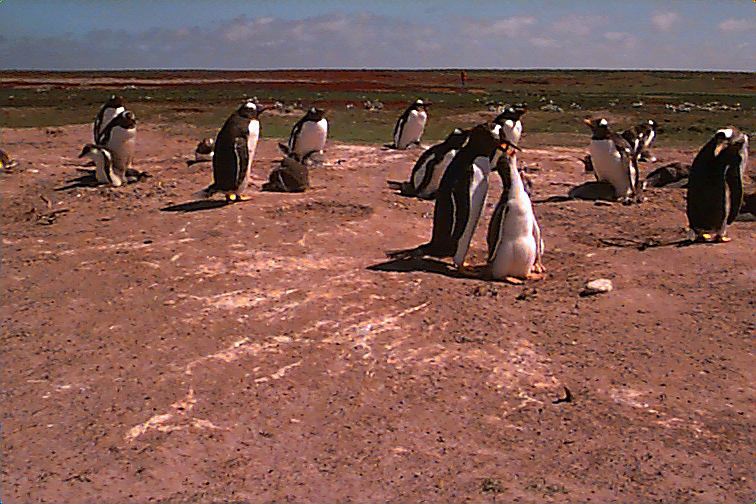
7), so named for obvious reasons, and the slightly larger gentoo penguins
(image 8). Gentoos are easily distinguished
from other penguins by their bright orange beak and white patches of feathers
that extend from above the eyes to the top of the head (image
9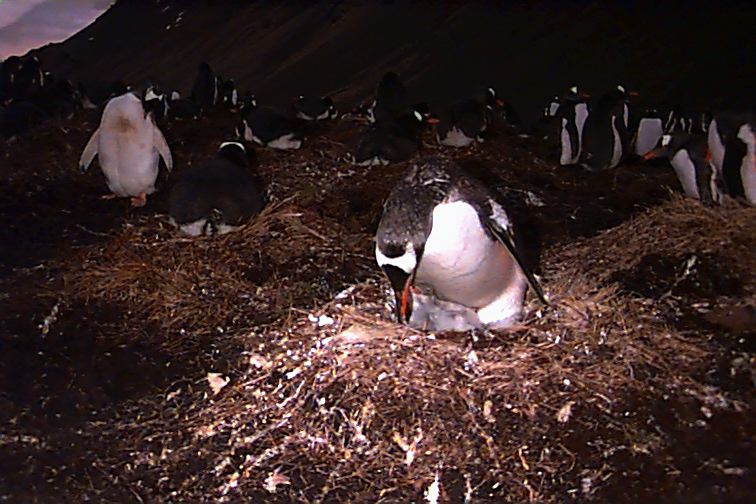 ).
They tend to be a little bit less tolerant of people, and they will nest
as far north as the Falkland Islands. However, it was not uncommon
for us to see an occasional gentoo penguin on or near station.
).
They tend to be a little bit less tolerant of people, and they will nest
as far north as the Falkland Islands. However, it was not uncommon
for us to see an occasional gentoo penguin on or near station.
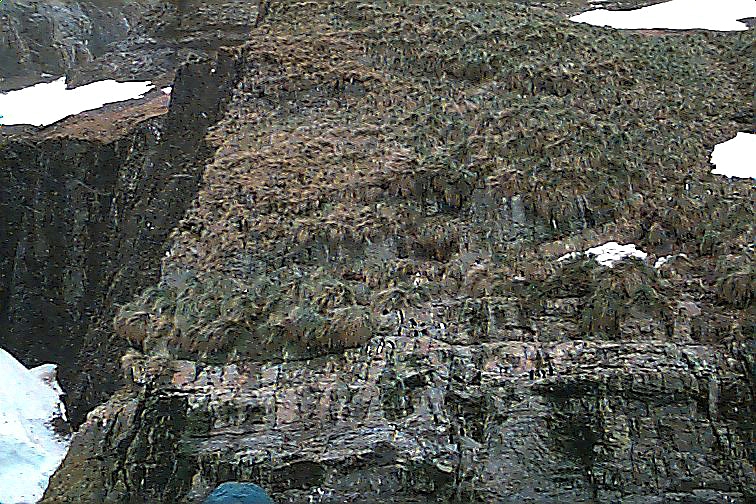
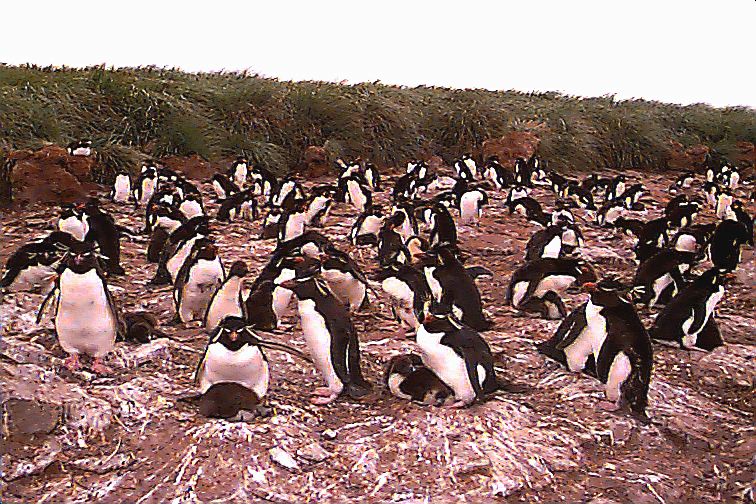
The macaroni penguin, with its yellow plumage above the eyes were so named by early British Antarctic explorers who were reminded of the ridiculous plumed hats worn by members of the famous Macaroni Club in London. They have been observed nesting on rocky cliffs (image 10) and in other seemingly inaccessible places. Their relative, the rockhopper penguin, is also fond of rocky cliffs as nesting sites. The rockhopper is quite a disagreeable little bird, and the rookery I visited was a continual cacophony of angry calls (image 11). They are also aptly named, and this became apparent to me as I watched one negotiate a pile of boulders.
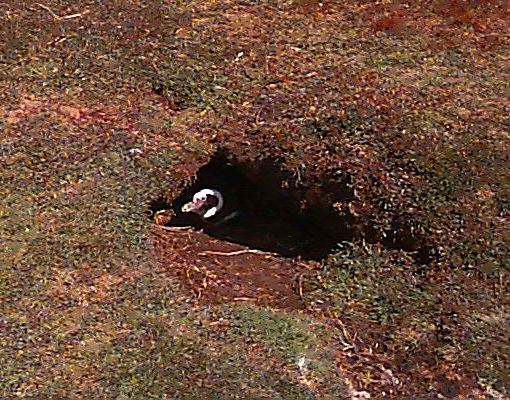
Penguins live all over, but exclusively in the southern hemisphere of the
planet, living as far north as the Galapagos Islands. In the Falkland
Islands I saw a species of penguins that is well known in South Africa
and Southern South America. The Magellanic penguin was the most timid
penguin I saw on my trip, living in burrows just below the ground (image
12), and promptly retreating there at the first sign of movement near
the burrow.
 Of course penguins aren't the only birds that reside in and around the
Antarctic. Many species of terns and petrels spend at least part
of the year near the Antarctic continent. In fact the south polar
skua (a hawk like scavenging bird of prey) has been seen as far as the
south pole! In addition, cormorants, or shags, are also found all
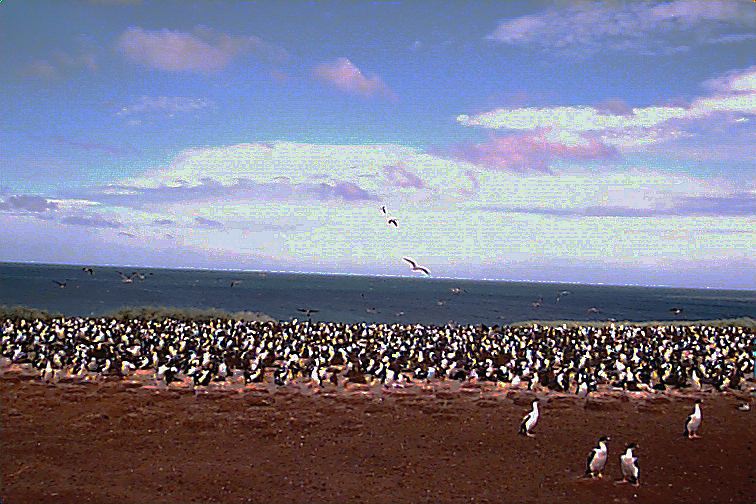
over the Antarctic. There were nesting colonies (image
13) of imperial cormorants near Palmer station as well as numerous
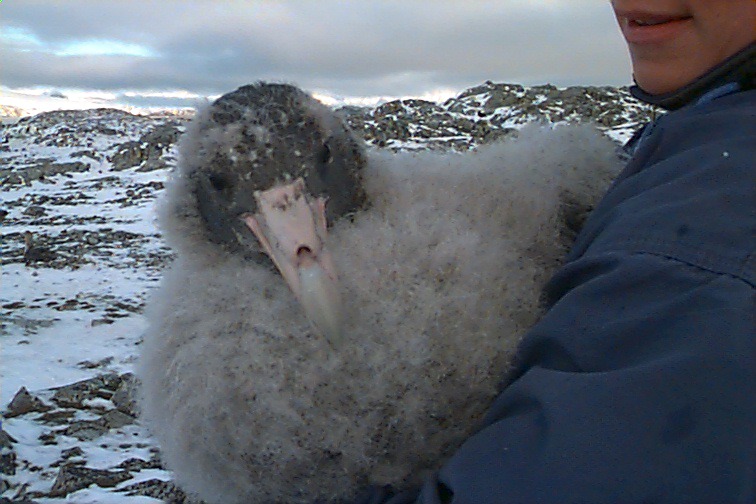
nesting pairs of giant petrels (image 14)
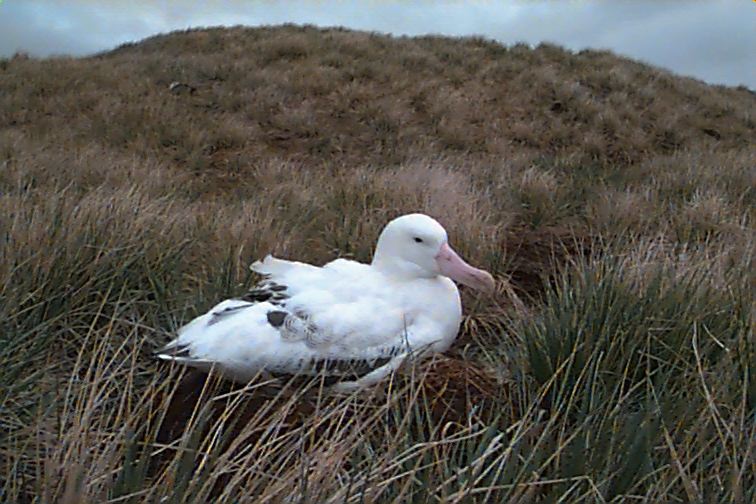
and skuas. But the most beautiful flighted bird I saw was the giant
wandering albatross (image 15). The
wandering albatross is the largest flying bird in the world, with a wingspan
of up to ten feet. It nests at the top of cliffs. They are
so large that they cannot take off in the normal fashion. They need
either a strong wind or they need to take off from atop a cliff in order
to gain enough speed to generate enough lift to keep its large body in
the air. Once in the air, they are very graceful, gliding along with
barely a wing beat.
Of course penguins aren't the only birds that reside in and around the
Antarctic. Many species of terns and petrels spend at least part
of the year near the Antarctic continent. In fact the south polar
skua (a hawk like scavenging bird of prey) has been seen as far as the
south pole! In addition, cormorants, or shags, are also found all
over the Antarctic. There were nesting colonies (image
13) of imperial cormorants near Palmer station as well as numerous
nesting pairs of giant petrels (image 14)
and skuas. But the most beautiful flighted bird I saw was the giant
wandering albatross (image 15). The
wandering albatross is the largest flying bird in the world, with a wingspan
of up to ten feet. It nests at the top of cliffs. They are
so large that they cannot take off in the normal fashion. They need
either a strong wind or they need to take off from atop a cliff in order
to gain enough speed to generate enough lift to keep its large body in
the air. Once in the air, they are very graceful, gliding along with
barely a wing beat.
The seals are also conspicuous members of the Antarctic wildlife community.
There are a number of different species, all of which spend some or all
of the year in Antarctic waters. The most common seal is the crabeater
seal. In fact, the crabeater is the most common large mammal in the
world. It's title is a misnomer, as there are no known species of
crab in the Antarctic. The main prey item of the crabeater is krill.
Krill comprise a large portion of the diet of all the animals that I have
discussed thus far. All Antarctic penguins, whales, and seals rely
heavily, sometimes exclusively on krill as a food source. Crabeaters
rarely come ashore, and will occasionally haul out onto seaice. They
are hunted by killer whales and leopard seals, and many animals bear the
scars of previous encounters with these predators. The weddell seal
(image 16) 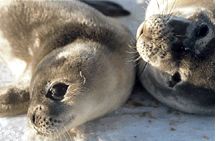 is
named for the early British explorers who first encountered these large
but docile creatures. The weddell seal is a curious animal, and will
frequently use dive holes cut by humans as a breathing hole. They,
too spend much of their time at sea, feeding on squid and krill.
is
named for the early British explorers who first encountered these large
but docile creatures. The weddell seal is a curious animal, and will
frequently use dive holes cut by humans as a breathing hole. They,
too spend much of their time at sea, feeding on squid and krill.
I saw many southern elephant seals (image 17)
during my trip. These large animals would frequently haul out to
pup or bask in the springtime sun. The males were simply enormous,
weighing up to five tons! They would compete with each other (image
18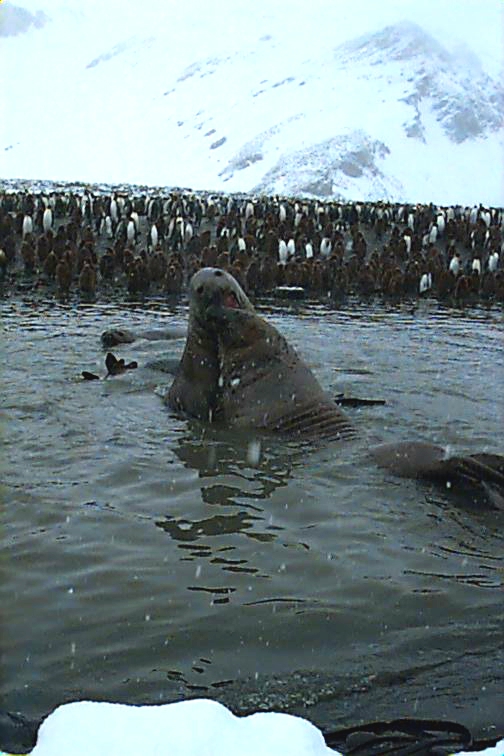 )
for the mating rights to harems of females. While these seals only
showed a mild disdain for man, I would certainly think twice before passing
too closely to a beachmaster.
)
for the mating rights to harems of females. While these seals only
showed a mild disdain for man, I would certainly think twice before passing
too closely to a beachmaster.
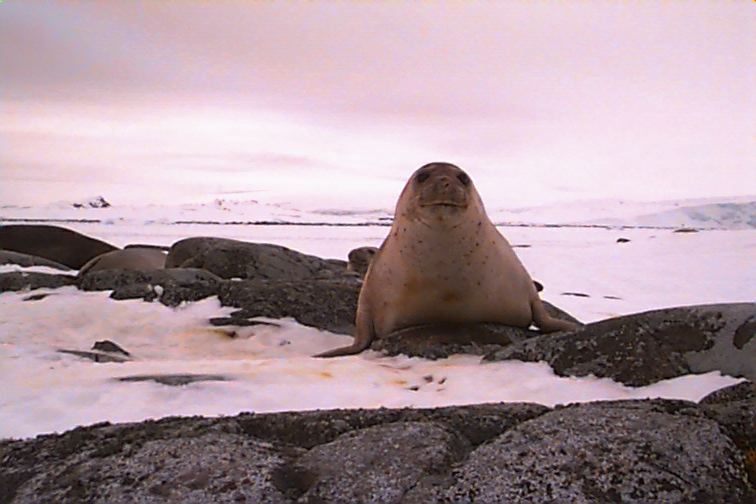
The leopard seal (image 19) is the most formidable of the seals. Although it, too, feeds on krill and squid, a main component of its diet is penguin and seal meat. Leopard seals will cruise off the coast of a penguin colony, waiting for an unsuspecting penguin, particularly an inexperienced juvenile, to enter the water. The leopard seal then pounces on its victim, flaying it by thrashing it against the surface of the water. Orcas are also known to do this to penguins. The leopard seal was of particular importance to us, as they are known to be aggressive towards divers (see the entry on Diving).
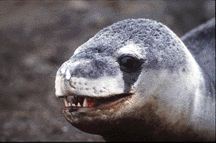
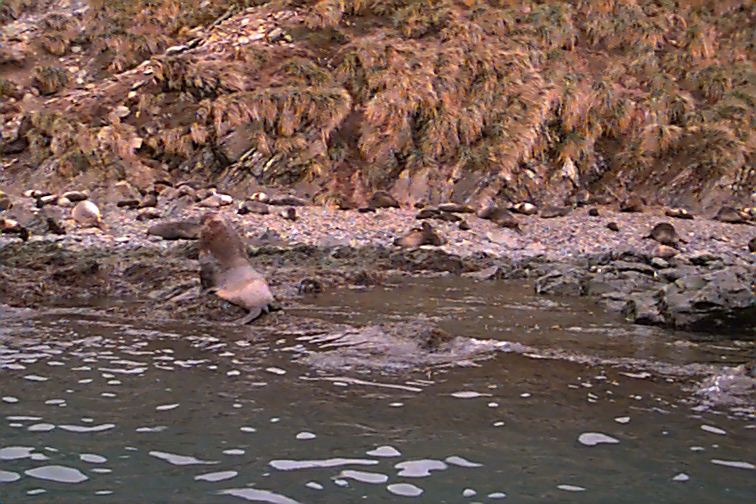
Finally there is the fur seal (image 20). Hunted nearly to extinction for it's pelt, populations have rebounded, shielded by the cessation of sealing in the early part of this century. Fur seals are related to sea lions, and can be differentiated from other seals by the presence of small ears (hence the scientific name Otorieds), and their ability to walk on their hind flippers. These seals are known to be aggressive towards man on land, primarily because we are seen as competition for mates. These animals will infest beaches as they form uneasy mating and pupping communities.
These are not the only species of seals and penguins in the Antarctic.
Ross seals are perhaps the least understood of Antarctic seals. Penguins
are numerous in species, ranging from the inner most reaches of the ice
shelves to more temperate regions of the southern hemisphere, particularly
the southern reaches of the southern continents. Unfortunately, I
did not have the opportunity to see all these animals, but it was a privilege
to see the species I did.
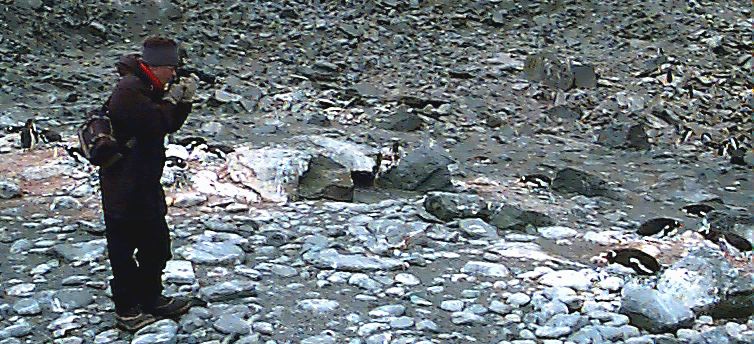 |
Dave photographing nesting gentoo penguins on Elephant Island, Antarctic Archipelago |