Demos about Waves
(Note: For many of these animations, the QuickTime 7
plugin for Firefox will only show the first second of time. Download
the file instead.)
Sound:
Sounds have pitches depending on the sound wave's frequency. Click here to hear a function generator
sweep the entire audible range of frequencies (20 Hz to 20 kHz).
It's supposed to be pure tones, although distortion in the speaker used
lead to some higher harmonics, especially for the lower pitches.
Speed
of sound in various materials, and here
too (and here is a site with an extensive list
for woods)
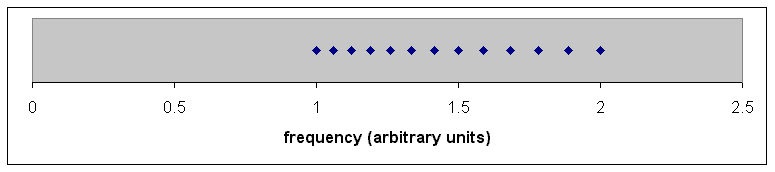
Here is a graph of the frequencies of the notes in the
equal temperament musical scale. Note that on a linear graph axis,
the notes get more widely spaced at higher frequencies. The
musical notes are spaced at equal ratios of frequency, not equal
increments of frequency.
Oscillations:
Waves and oscillations are different things, but there is
a close relationship between them.
Cosine
Grapher : This Excel spreadsheet allows you to vary the
parameters in a cosine oscillation, to see how it effects the graph.
Oscillations and Circles : These are
closely related, as illustrated here
.
Superposition:
This Excel spreadsheet makes it easy to superpose
two cosine oscillations.
This Excel spreadsheet is very similar to the
previous one, but it adds 6 cosine
oscillations together. Note that in this one you control
frequency, while in the previous one you control period.
Making
Waves (from PhET) is a
Java application that allows you to superpose many waves, and to hear
the result. It has to be downloaded.
Types of Waves:
There are many different kinds of waves,
with different characteristics.
This interactive
wave applet (from PhET)
lets you make transverse waves directly.
Longitudinal waves can be described by their displacement or their
density. This PDF
shows how those relate.
Huygen's Wavelets:
The following "animations" illustrate that a set of closely spaced
point sources nicely approximates a non-point source. The motion
in the movies does not represent anything evolving in time.
Instead, each frame represents a snapshot of a wave with a particular
source configuration.
- This primarily illustrates that a line
of point sources looks like a linear source, if the source is
large enough compared to the wavelength.
- This has the same setup, but focusses on the end of the line of
sources. As justified by Huygen's wavelets, this is equivalent
to a wave passing through a hole.
You can see that the smaller hole, the more the wave diffracts around
the corner.
- This focusses on the end of a long line of sources. As
justified by Huygen's wavelets, the is equivalent to a wave
passing by an edge. Here the wavelength is varied, and you
can see that longer wavelengths diffract slightly more.