Sustainability at CAS
Below is a list of environmental initiatives implemented by SUNY Geneseo Campus Auxiliary Services (CAS). If you have any suggestions or would like to become involved in the CAS Sustainability Committee, please contact us at cas@geneseo.edu.
In addition to participating in the college's Sustainability Commission, CAS has created its own sustainability committee devoted to researching, presenting, and implementing sustainability recommendations.
- Executive Order 32 (EO32)
- Prime Vendor Agreement
- Phasing Out SIngle-Use Plastic
- Composting
- High-Efficiency Laundry Machines
- Waste Cooking Oil Recycling
- Catering Recycling Program
Executive Order 32 (EO32): Purchasing Goals for NYS Agriculture Products
For the past several years, CAS focused on increasing the number of local foods served in the on-campus restaurants and cafés. We realize the economic impact that spending locally can have on the community as well as the flavor and nutritional benefits of eating local foods. Our produce is purchased from American Fruit and Vegetable, a produce distributor based out of Rochester, NY. Working with the produce distributor, we can increase the number of local fruits and vegetables offered throughout campus as growing seasons allow, buying from over a dozen regional farms. We also partner with Upstate Farms, a local dairy co-op that has over 300 New-York-based, family-owned co-op farms to supply all of our milk and most other dairy products. The interactive map below features all of our current vendors and local produce providers!
Prime Vendor Agreement
CAS is committed to sustainability. There are many decisions we make that impact sustainability on the SUNY Geneseo campus, like choosing a prime vendor. Our prime vendor comes to campus three times a week, making deliveries to each dining location. The prime vendor agreement is used to maximize our spending power and promote an efficient, one-stop delivery concept.
Palmer Food Services is our main source for bringing healthy products, including some local options to campus. Any vendor can supply products, but it's what makes each company unique that truly makes a difference. As a family-owned business, Palmer has been a Rochester institution for over 100 years. When choosing our vendor for the current academic year, we were looking for a vendor that was able to supply an assortment of products needed for our diverse dietary and ethnic communities and an excellent source for locally or NYS-based products.
Sustainability is one of our priorities on the SUNY Geneseo campus. We ensure that our prime vendor can contribute to our efforts. Palmer Food Service is located 30 miles from Geneseo, which makes for a shorter commute for deliveries. They do business with over 90 NYS-based companies and sources of products, and they employ 675 people that live in the greater Rochester area.
Phasing Out Single Use Plastic
CAS migrated to a high-quality, environmentally friendly line of compostable food containers and cutlery, and it is our goal to recycle all single-use plastics.
We use World Centric bamboo utensils, an eco-concious and compostable alternative to plastic. This molded fiber product is made of discarded sugarcane and rapidly renewable bamboo fibers, reducing a source of plastic leakage into the environment. The benefits also include:
- Reduced cross contamination with the touchless capability
- Use less energy to manufacture
- Made from annually renewable plants like bamboo and sugarcane bagasse
- Non-polluting, non-toxic, and break down in a commercial composting facility
- Help to save biodiversity and habitats
We encourage those who choose to dine in to use on-site cutlery and dishes to aid in our sustainability mission.
Composting
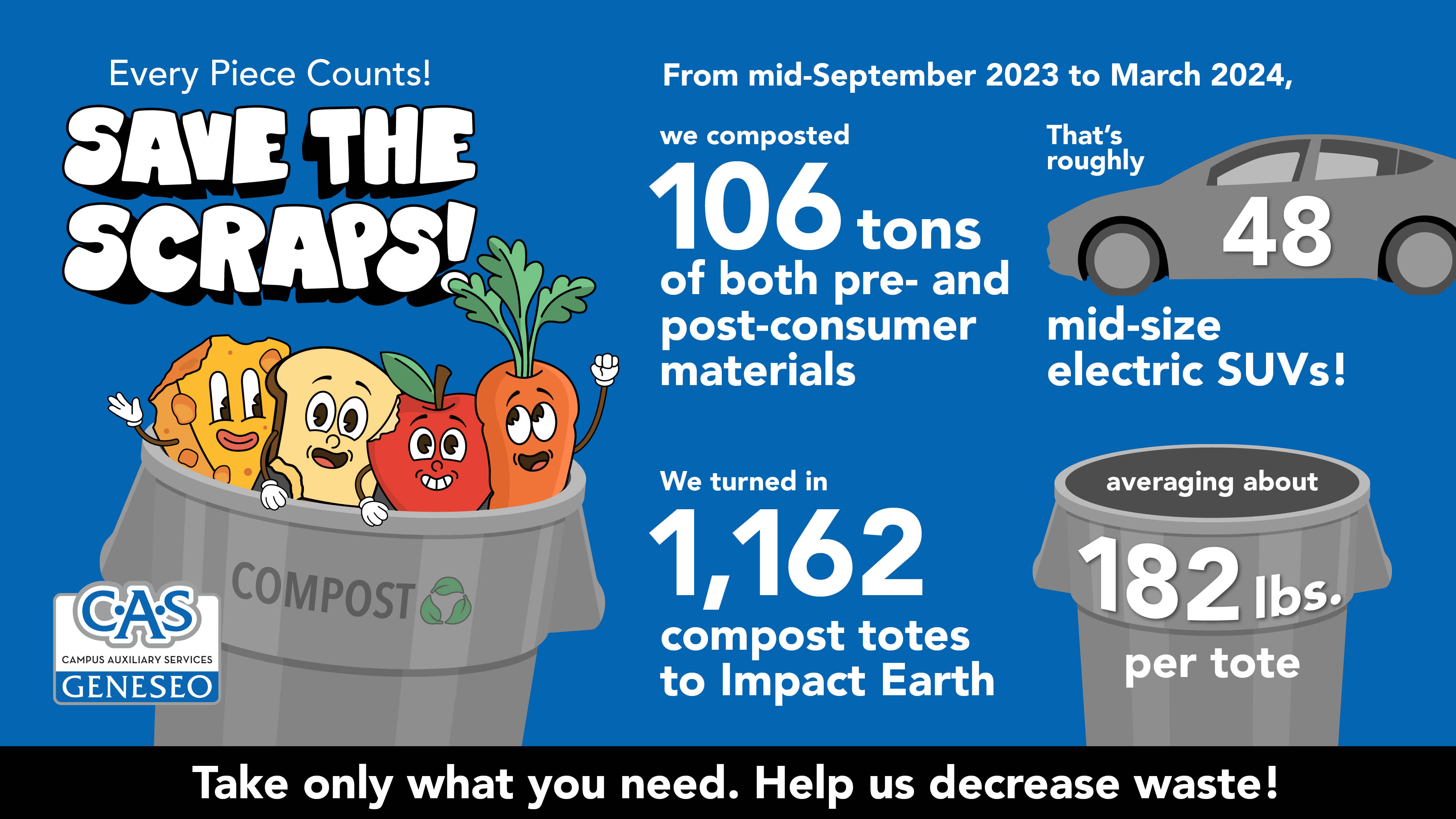
Starting in the Fall of 2023, CAS entered into a partnership with Impact Earth composting for the collection of organic waste from our on-campus dining areas. Impact Earth is a local company and network of environmentally-minded individuals who aim to reduce single-use consumption and divert materials from ending up in landfills. Their mission is to create a sustainable future and CAS is proud to enter a new era of sustainable practices at SUNY Geneseo!
CAS composts all food scraps from the Culinary Support Center (CSC) in Letchworth where all of the grab-and-go items throughout campus are produced. We also collect the post-consumer compostable material at Red Jacket, Letchworth, and Mary Jemison which is picked up by our partners at Impact Earth. Red Jacket has a machine that "digests" the food waste and grinds these scraps into a compostable pulp.
Image
High-Efficiency Laundry Machines
In 2007 CAS started providing high-efficiency laundry machines. The washers and dryers in residence halls and townhouses on campus were replaced with high-efficiency front-loading washers and dryers that significantly reduced water and energy usage. By the fall of 2009, the entire campus was equipped with the new machines.
As of May 2016, almost 11,000,000 gallons of water have been saved due to the switch to the new machines.
In addition to the water saved, the laundry machines also require significantly less detergent and remove excess water from the clothes, reducing the amount of time and energy needed to dry them.
Waste Cooking Oil Recycling
Currently, all waste cooking oil generated by the fryers on campus is collected and picked up by a company that recycles the product, keeping it out of the waste stream.
Catering Recycling Program
Many of the conference rooms throughout campus do not have recycling containers, and we found, through observation, that most of the cans at catering functions were thrown out instead of recycled. To help provide a solution, CAS began delivering recycling bins as a part of our catering setup for deliveries of canned soda or bottled water. CAS also participates in a recycling program that helps provide support to Arc GLOW. Designated recycling bins are in place at Letchworth, Mary Jemison, and Red Jacket, 1871 Market, Blake-A, and MacVittie College Union where bottles and cans are picked up by Arc GLOW and used to create job opportunities for individuals with intellectual and developmental disabilities.