For Immediate
Release—Friday, Oct. 27, 2006
Contact:
Mary E. McCrank
Media Relations Officer
(585) 245-5516
SUNY Geneseo Professor's Study
Opens New Window on our Geological Past
GENESEO, N.Y. –
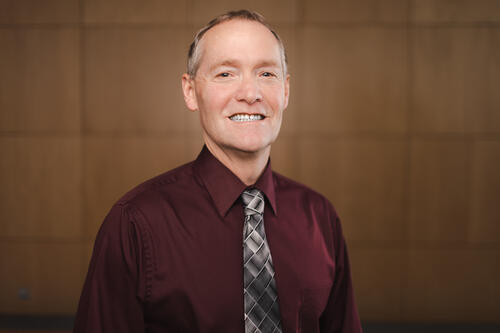
Richard A. Young, a distinguished service professor of geological sciences at
the State University of New York at Geneseo, has recently completed research in
the Genesee Valley that will have profound implications for climate research
worldwide. His work, presented in the April 2006 issue of the international
journal Geomorphology, is
entitled, "Middle Wisconsin glaciation in the Genesee Valley, NY: A
stratigraphic record contemporaneous with Henrich Event, H4."
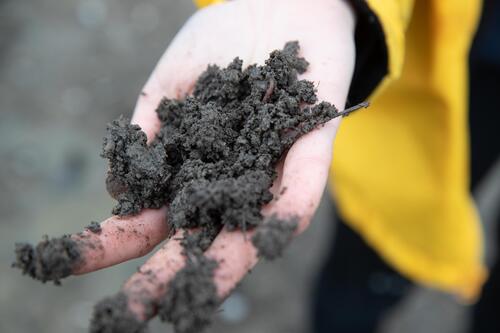
Young's research encompasses
a 10-year study of a unique glacial site in northern Livingston County. The
site has yielded 68 samples for radiocarbon analysis preserved by two closely
spaced glacial advances, including spruce trees, mollusks, mammoth bones and
remarkably preserved plant remains.
Radiocarbon dating of the
samples found at the site shows that two ice advances occurred during a short
interval centered about 35,000 years ago. This evidence extends the known
glacial history of western New York and eastern North America back by 30,000
years to Middle Wisconsin time.
"Nearly all of the existing
evidence for the glacial history of New York and eastern North America has come
from studies of deposits formed during the last ice advance, beginning about
21,000 years ago," says Young. "That ice sheet melted northward into Lake
Ontario about 12,500 years ago, an interval known geologically as Late
Wisconsin time. My research shows
that there was an ice advance south of Lake Ontario in Middle Wisconsin time,
something which there was previously no evidence for."
"Not only does the research
provide evidence for an ice advance in Middle Wisconsin time, but it also is
evidence for strange ice sheet behavior in other parts of the world besides
Greenland and the North Atlantic during the time period. Strange ice sheet
behavior in our part of the world was previously only proven for Late Wisconsin
time," says Young.
Young says his research
could have a huge impact on the way scientists study climate change. "We now have a much better evidence for
the direct linkage between ice advances in the North Atlantic and the eastern
continental United States. This implies that global climate events are more
strongly linked than previously realized," says Young.
"There has been a lot of interest in studying the evidence
for abrupt global climate change lately," says Young. "Studies such as these
provide well-documented points in time that are valuable for researchers
attempting to explain the sudden climate changes that many believe we are
seeing on our planet today."
Young says that these
findings also provide strong incentives for geologists elsewhere in New York to
locate evidence of this important Middle Wisconsin event in other large valleys
in the Finger Lakes Region.
Young, originally from East
Greenwich, R.I., has been a professor at Geneseo since 1966. He received his
bachelor's degree in geology from Cornell University in 1962 and his doctorate
degree in geology from Washington University in St. Louis in 1966. On top of
his work on the glacial history of the New York area, Young also is known for
his research on the history and formation of the Grand Canyon.
The co-author of the Genesee
Valley article is George S. Burr, a faculty member at the University of Arizona
radiocarbon dating facility. Burr provided most of the radiocarbon ages of the
samples found at the Livingston County site under a cooperative research
program of discretionary research support. Other portions of the study were
supported by funds obtained by Young from SUNY Geneseo.
###
Written by Joe Mignano,
public relations intern in the Office of Communications and Publications.