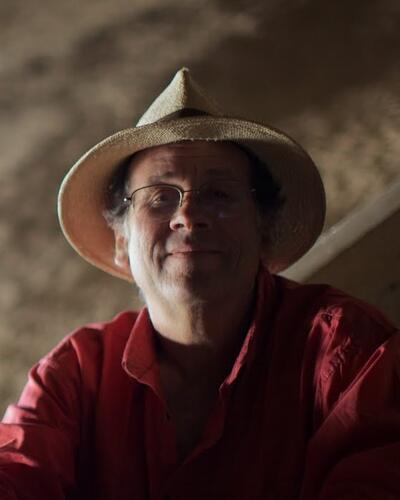
Steve Derné has been a member of the Geneseo faculty since 1993.
For more information, visit Steve Derné's Curriculum Vitae.
Office Hours
Tuesday & Thursday: 1:40pm-3:10pm
Other hours available by appointment
Curriculum Vitae
Education
Ph.D., University of California, Berkeley
Publications
Derné, Steve. 2023."Tantra and Technology: Practicing Wonder in Daily Life (Eat, Walk, Love, See)." Motilal Banarasidass
Derné, Steve. 2017. "Sociology of Well-Being. Lessons From India." Sage Publications India Pvt Ltd
Derné, Steve. 2008. "Globalization on the Ground. Media and the Transformation of Culture, Class, and Gender in India." Sage Publications Pvt. Ltd
Derné, Steve. 2000. "Movies, Masculinity, and Modernity: An Ethnography of Men's Film going in India." Greenwood Press
Derné, Steve. 1995. "Culture in Action: Family Life, Emotion, and Male Dominance in Banaras, India." SUNY Press
Interests
- Well Being
- Mystic Experiences, Peak Experiences & Supernatural Encounters
- Wonder
- Wander
- Religion
- Emotion
- India
- Himalayan Cultures
- Burma
- Pacific Islands
Classes
-
SOCL 218: Soc of Environmental Issues
This course deals with the application of social science theory and methods to the study of the ever changing relationship between humans' natural and social environments. Thematic emphasis on Environmentalism as a socio-political, economic movement will inform the course. Topics include an analysis of the historical context of perceived tensions between these two environments and the changing social definitions of nature and environment. Particular attention is given to major environmental controversies and related political struggles of the past two centuries. Additionally, select environmental problems are used as a vehicle from which to explore the nature of sociology' potential contributions to the resolution of environmental controversies. Prerequisites: Any 100-level Sociology course. Offered every year
-
SOCL 302: Sociological Research
The design and implementation of empirical research in sociology. Examines the logic of social inquiry and the uses and problems of various research designs and methods of data collection. Particular emphasis is on analysis of available data and survey research.
-
SOCL 381: Topic: Nonordinary Experience
An intensive study of a topic in sociology not covered in depth in other courses or, alternatively, an attempt to integrate two or more paradigms or converging perspectives in the field to be studied. (May be taken for credit no more than twice.) Prerequisites: Any 100-level Sociology course or permission of instructor. (Some topics may require additional prerequisites.) Offered every year