

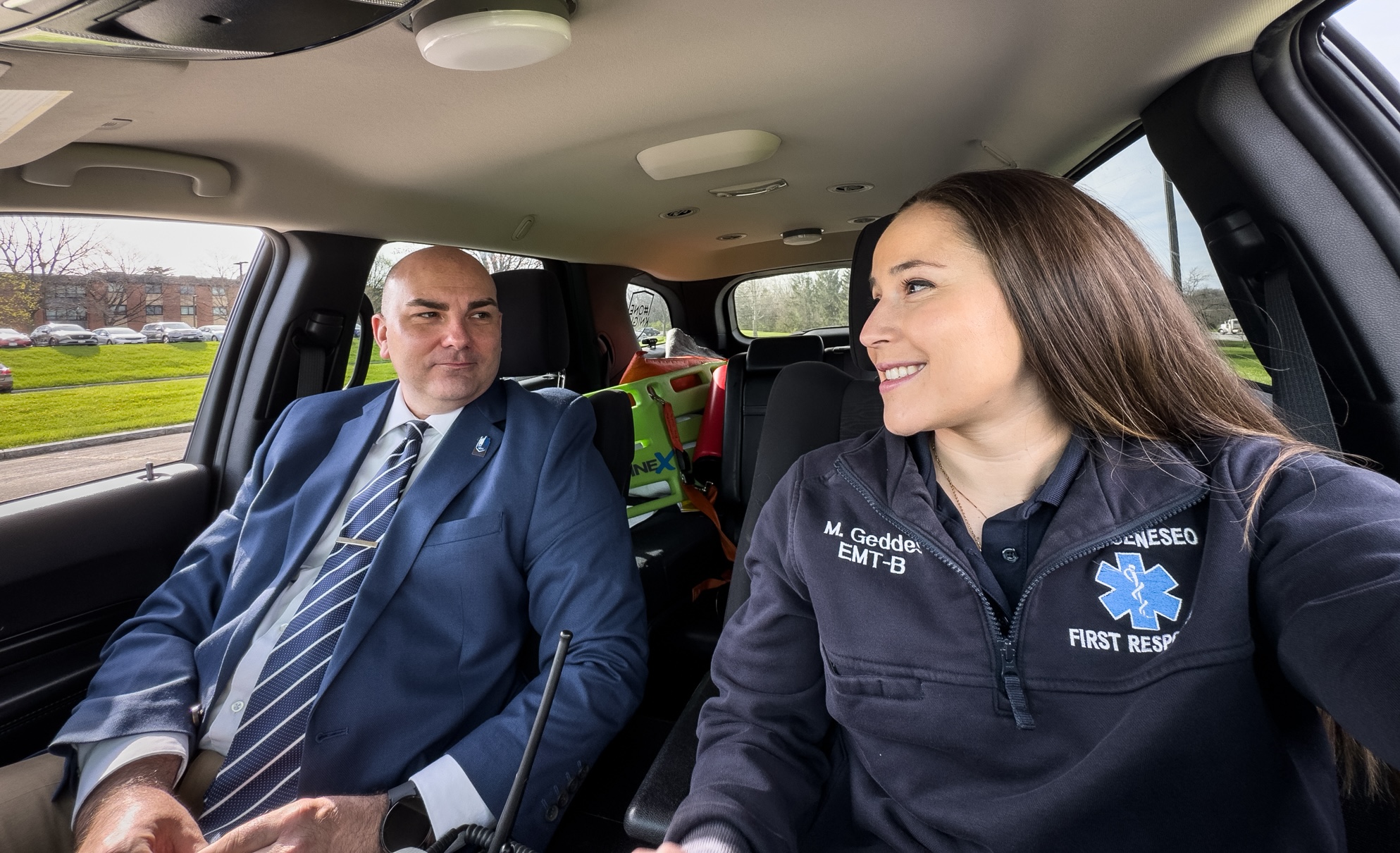
Meet the alums whose careers in health care and emergency response were inspired by Geneseo First Response.
By Kris Dreessen
Are you an alum of GFR who chose a career in the health fields or as a first responder? We’d love to hear from you! scene@geneseo.edu. Contribute to the GFR fund.
Last year, Madison Geddes ’24 and Geneseo First Response crews of emergency medical technicians answered more than 200 calls around campus, regardless of whether it was 3 a.m. or 3 p.m.
The EMTs who responded to the calls were student volunteers.
“The calls all came from college students who didn’t know what to do in a situation—and they called us for help,” says Geddes, who served as chief of operations. “They were thankful to have a fellow student care for them in their time of need. We can sympathize and have a connection with them, because we are their peers.”
Peer-to-peer service is one of the things that makes GFR special. Since 1974, student volunteers have received emergency training and taken on work shifts in addition to their course loads in order to respond to injuries, illness, and other crises on campus.
Fifty years ago, GFR started with a handful of eager students and access to a simple van. In 2023–24, the group boasted 55 active members who responded to calls in specialized SUVs, running shifts 24/7 during the academic year. In 2022–23, GFR volunteers gave a collective 20,000 hours of service to the organization.
GFR has an independent operating budget. Crews are dispatched through 911 and run staff shifts 24/7 during the academic year. They provide basic life support until ambulance crews arrive, such as patient stabilizaton, CPR if necessary, and other actions. Operation directors like Geddes collaborate with Livingston County EMS and Geneseo’s University Police Department (UPD).
UPD police chief Scott Ewanow ’06 was one of 60 current and past GFR crew members who gathered on campus last spring to celebrate all they’ve accomplished in 50 years.
Meet Ewanow and two other GFR alums who have made careers of health, emergency response, and public service:
Scott Ewanow ’06
Chief of Police, SUNY Geneseo University Police Department
GFR member 2002–2006
As the college’s chief of police, Ewanow oversees all operational aspects of UPD, including investigations and uniformed patrol operations. He also serves as chair of the GFR board, providing strategy and mentoring.
“GFR runs as their own supervised but well-oiled machine that needs little supervision,” says Ewanow. “Sometimes I wish they needed a little more, but it shows the caliber of the students. They are very driven and motivated.”
Ewanow was in GFR all four years at Geneseo while he studied to be a history teacher, but he instead chose a career in law enforcement. He started as a police officer at SUNY Cortland in 2007 before coming to Geneseo in 2010, rising in the ranks to become chief in 2022.
University Police respond to every medical call on campus as part of protocol, and Ewanow appreciates that GFR is part of that response.
“Officers love it, because though we have medical training, we are not EMTs like the students,” says Ewanow. “They are always like, ‘We got this,’ and jump right in.”
Ewanow helped resuscitate a student during his tenure in GFR, and GFR members have done so since he has worked in UPD.
“Geneseo First Response students are very professional,” says Ewanow, “and ready to respond all hours of the day.”
Eric Rathfelder ’05
Criminal Investigations Sergeant, Rochester City Police Department
GFR member 2002–2005, captain (now called director of operations) 2003–2005
Eric Rathfelder ’05 taught physics in the Greece Central School District for seven years, until teaching no longer felt like the right fit. Law enforcement did.
“I wanted to try something new,” says Rathfelder. “I was ready for a change.”
Rathfelder started a second career as an officer with the City of Rochester Police Department, patrolling overnight in the city’s Clinton Section. He now works as an investigative sergeant in the city-wide Ccriminal Investigations Section. Rathfelder has also served as a paramedic since 2006, and now currently works per diem for CHS Mobile Integrated Healthcare ambulance service in Monroe County.
Recognized at the GFR 50th celebration, he’s impressed by what GFR has accomplished. In parts of 2004 and 2005, Rathfelder says, it had only a skeleton crew, who took on extra shifts to ensure coverage. They worked hard to demonstrate that an EMS first response organization is a vital critical service for campus and should be permanent.
During Rathfelder’s tenure, members obtained a legitimate emergency response vehicle, achieved a sustainable GFR operating budget, integrated into the Livingston County 911 dispatch system, and purchased a modern AED, which was ultimately used by GFR members (including UPD Chief Scott Ewanow ’06) to resuscitate a student in cardiac arrest shortly after Rathfelder graduated from Geneseo.
“We didn’t know at the time it would be used to save a life,” he says, “but we knew it was important to lay the groundwork in case it was ever needed.
“It is certainly satisfying to see that volunteers are now a critical part of the emergency response structure at the College.”
Kelsey Costello Parnell ’17
Nursing Manager
GFR chief of operations 2016–17
As director of GFR operations, Kelsey Costello Parnell ’17 loved helping students with other squad members so much that she left her position in the college transportation and parking office for a new career.
“I had been a psychology major but wasn’t really sure where my path would take me,” says Parnell. “I yearned to give back to the community, like when I was involved with the first response team.”
Parnell completed her nursing degree through the University of Rochester’s accelerated 12-month program.
“It was a jam-packed year,” she remembers, “but I learned so much. My foundations at Geneseo really set me up for success.”
Parnell held several nursing positions at Highland Hospital in Rochester, NY, before becoming assistant nurse manager in 2021 and nurse manager in 2022, managing approximately 50 nurses and support staff for an 18-bed inpatient unit. Some of those patients were in palliative care.
“That’s where I first got a taste of helping people along their journey and through death with dignity and helping families in our community navigate the end-of-life process,” says Parnell. “People can die a good death, and it takes a bit of specialized care to do that.”
With Parnell’s advocacy, eight of those unit beds are now dedicated to caring for end-of-life patients.
Parnell was recognized at the GFR 50th celebration and shared some of her experiences and lessons with attendees.
Three years in GFR, she says, gave her the ability to understand that even when the path ahead is difficult, finding the right supports will help you navigate it successfully. She believes the value of empathy can’t be overstated.
“You don’t know what other people are going through or what struggles they have,” says Parnell. “Something that might not seem like a big deal to you may be a very, very big deal to someone else. You see people at their lowest and most scared. It’s important to take a second to check in on ourselves—and to be kind.”
.