

A collection of luggage tags from five continents highlights the Golden Age of Travel.
By Robyn Rime
The Special Collections in Fraser Hall Library range from college memorabilia to local historical documents to rare, fragile, and valuable artifacts. It’s easy to see why some of the items ended up at the College. Faculty publications, decades of old yearbooks and campus newspapers, and posters from SUNY Geneseo events in years past all populate the College Archives. Papers and photos from the Genesee Valley and its first settlers, the Wadsworth family, span more than 150 years of the region’s history. But other items are puzzling, their provenance less directly tied to the College. In this ongoing feature, the Scene will highlight some of the unusual, intriguing, and often unique objects in Geneseo’s Special Collections.
Luggage tags and labels, 1930s–1960s
This collection of hundreds of luggage labels and tags was donated to the College by Gerard J. Hasenauer, a professor in the foreign languages department in the 1960s and ‘70s. Some of the tags bear his name, but most are blank and many are multiples of the same tag, suggesting they were gathered specifically for the collection.
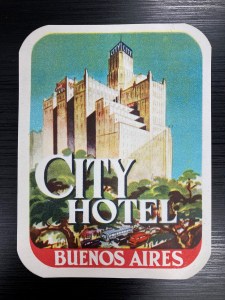
The labels and tags represent widespread travel across five continents (excluding only Asia and Antarctica), with a heavy emphasis on South America and northern Europe. It’s possible—probable, even—that Hasenauer didn’t visit each location himself. Several of the labels identify other travelers, and a tag-stuffed envelope from the Baggage Department of the Cunard White Star Line, postmarked 1941, suggests Hasenauer may have written to request samples to add to his collection.
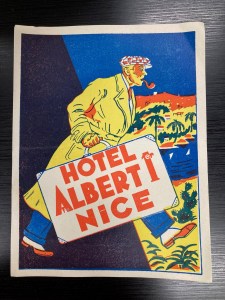
Luggage tags and labels were issued by hotels, ocean liners, and airlines around the world and were popular in the early 20th century, or the Golden Age of Travel, when mass tourism took off. Luggage tags—the kind with strings attached—were primarily for identification, but luggage labels carried an extra cachet. In addition to serving as free publicity for tourist and hospitality venues, they also symbolized the luxury lifestyle of elite travelers. Most early labels were actually lithographed, and some featured work by esteemed graphic artists of the era. The high quality of both design and printing contributed to many labels being considered as tiny works of art. The labels lost popularity by the 1960s, when soft-sided suitcases replaced hard luggage, but they are still sought by collectors for their portrayals of faraway lands and exotic locales.
Related Stories
No post found!