

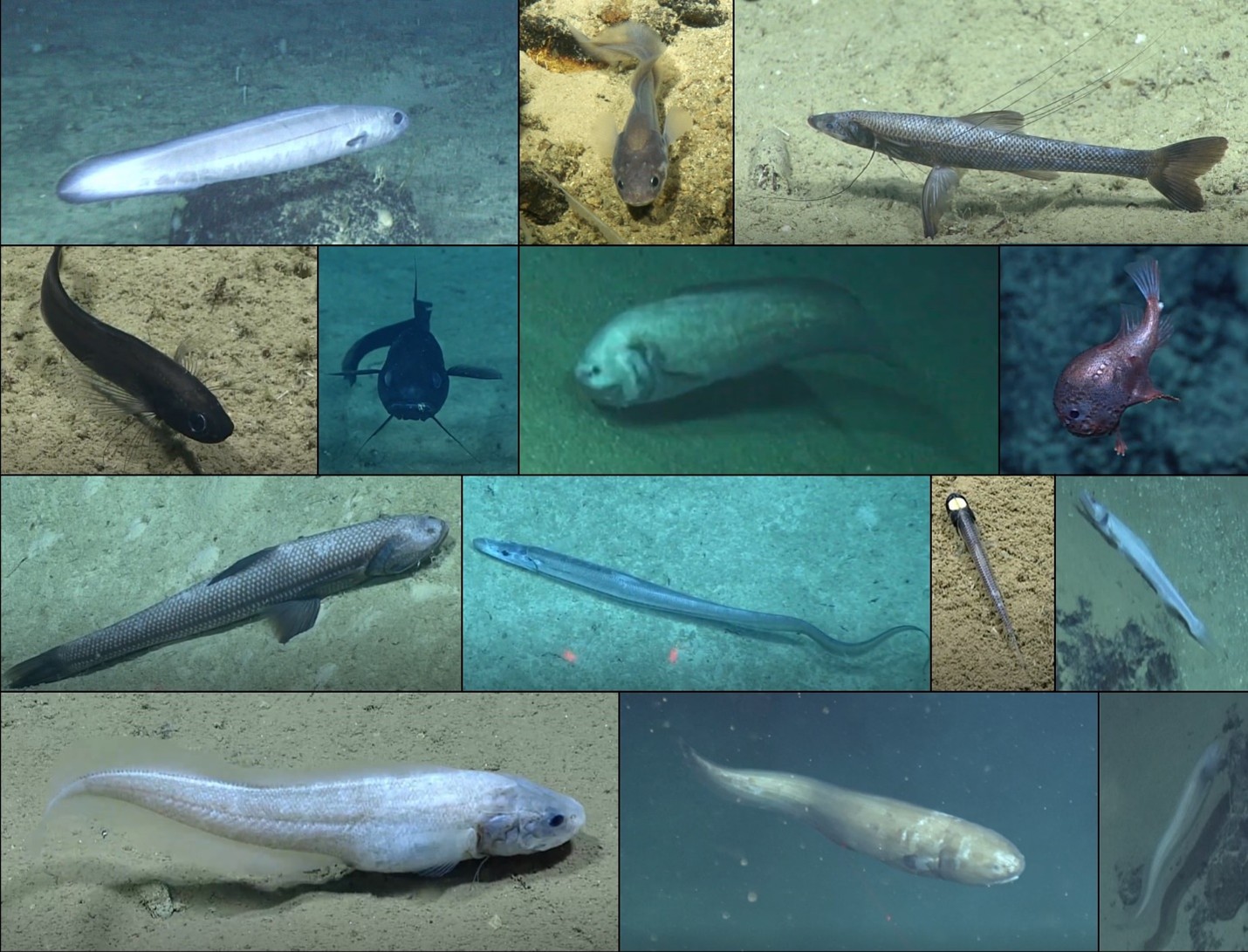
Example fishes found from depths 800 to greater than 6000 meters in the present study. Fishes are less diverse in color and form than the shallower-living species, with most species elongate and brown in color. (Photo provided)
Author
Publication
ICES Journal of Marine Science (2026)
Additional authors
Chryssanthi Tzetzis, Jacob Calus, Abisage Sekarore, Erin Patton, Julia Cappiello, Emily McMahon, Nikki Fuller, Gabriel Rosado, Allison North, A J Petty, Benjamin McPherson, Emily Morgan, Christopher Cook, Cole Janda, Andrew Kareeparampil, Olivia Knudsen, Brooke Licata, Peyton Mackey, Nathan Phillips, Megan Roell, Catie Sawyer, Makena Scarlata, Giovanna Sineo, Evan Weaver, and Brett H Woodworth (SUNY Geneseo); Kasey Cantwell (NOAA Ocean Exploration); Daniel Wagner (NOAA Ocean Exploration, Ocean Exploration Trust); Brian RC Kennedy (NOAA Ocean Exploration, Ocean Discovery League, Boston University); Thomas Morrow, Samuel Candio (NOAA Ocean Exploration); S Adam Soule (University of Rhode Island); Anna P M Michel (Woods Hole Oceanographic Institution); Andrea M Quattrini (Smithsonian Institution); and A Leitner (Oregon State University).
Article title
“Observations of deep-sea fishes at depths 250 to 6300 m off Puerto Rico”
Abstract
Earth’s largest habitats, the deep oceans, are home to an incredible diversity of organisms that are adapted to low light, cold temperatures, often limited food availability, and high hydrostatic pressures. With increasing habitat depth, these environmental variables and a long evolutionary history drive biodiversity shifts across deep-sea communities. However, the relative influences of physical and biological factors in structuring deep-sea community composition remain complex to disentangle. Here, we document shifts in the biodiversity of fish assemblages with increasing depth in the tropical Atlantic Ocean and Caribbean Sea using remotely operated vehicle and human occupied vehicle surveys across a 6000-meter depth range. We show significant declines in fish assemblage biodiversity and abundance with increasing depth based on 1137 observations of at least 94 species of fishes. These changes correlate strongly with co-varying environmental factors such as declining temperatures and increasing hydrostatic pressure. Habitat also influenced observations, with no pelagic taxa seen here deeper than 1200 m and with fishes most commonly observed over soft, rather than hard or mixed substrates. These findings add to our understanding of deep-sea fish biogeography, with expanded depth and regional ranges for multiple taxa. At abyssal and hadal depths in and around the Puerto Rico Trench, most observations were of cusk eels in the family Ophidiidae, highlighting the importance of this understudied group to ultradeep ecosystems. These findings demonstrate the value of in situ observational approaches to study deep-sea fish ecology and behavior and inform understanding of how changes in temperature and pressure influence biodiversity across depth.
Main research questions
1. Which fishes live at which depths in the deep sea?
2. How does the diversity of deep-sea fishes change with increasing depth?
3. What factors influence where fishes live in the deep oceans?
What was already known
The deep Caribbean Sea and tropical Atlantic Ocean have been surveyed by trawl nets, submersible dives, and remotely operated vehicles for decades, building a foundational understanding of the fishes that live in this region. This study adds to existing observations, allowing better understanding of biogeography and the factors that control where species live.
What the research adds to the discussion?
This study documents 1137 observations of deep-sea fishes in their natural habitat, building understanding of biodiversity in this region. These observations highlight the need for fishes to evolve specialized adaptations to live in deep-sea habitats, with both the number of observations and diversity of species declining at great depths. This study provides further support to previously documented ideas, including that fishes are often elongated or eel-like at greater depths, potentially to aid with efficient swimming or using the sensation of vibrations in the water to understand their dark environment. Being able to observe deep-sea fishes in their environment sheds light on not only which species live where, but how these animals interact with other species and with their environment.
Implications for society
This study was conducted as a Course-based Undergraduate Research Experience, or CURE, where students are scientists in the classroom. Students conducted this research in small teams, generating hypotheses, collecting and analyzing data, and writing about their results. Research experiences have been shown to enhance undergraduate education, skill development, and students sense of belonging in the sciences, and bringing these experiences directly into lab courses increases the accessibility of these experiences.
Funding sources
The authors received funding support from the National Marine Sanctuary Foundation and National Oceanic and Atmospheric Administration (NOAA) Ocean Exploration (Ocean Exploration Education Grant #22–01-B-417 to M.E. Gerringer, #NA21OAR0110202 to A. Quattrini, E. Cordes, A. Collins, B. Phillips) and the National Science Foundation (OCE #2129431 to S. Soule, IOS #2407551 to M.E. Gerringer) for this study.
Citation:
Gerringer, M.E., Chryssanthi Tzetzis, Jacob Calus, Abisage Sekarore, Erin Patton, Julia Cappiello, Emily McMahon, Nikki Fuller, Gabriel Rosado, Allison North, A.J. Petty, Benjamin McPherson, Emily Morgan, Christopher Cook, Cole Janda, Andrew Kareeparampil, Olivia Knudsen, Brooke Licata, Peyton Mackey, Nathan Phillips, Megan Roell, Catie Sawyer, Makena Scarlata, Giovanna Sineo, Evan Weaver, Brett H. Woodworth, Kasey Cantwell, Daniel Wagner, Brian R.C. Kennedy, Thomas Morrow, Samuel Candio, S. Adam Soule, Anna P.M. Michel, Andrea M. Quattrini, A. Leitner (2026). Observations of deep-sea fishes at depths 250 to 6300 m off Puerto Rico. ICES Journal of Marine Sciences, 83(1), fsaf234. doi: 10.1093/icesjms/fsaf234
More Research Briefs
Call for Research
We invite SUNY Geneseo faculty to submit peer-reviewed research from the last three years to be added to this site.