
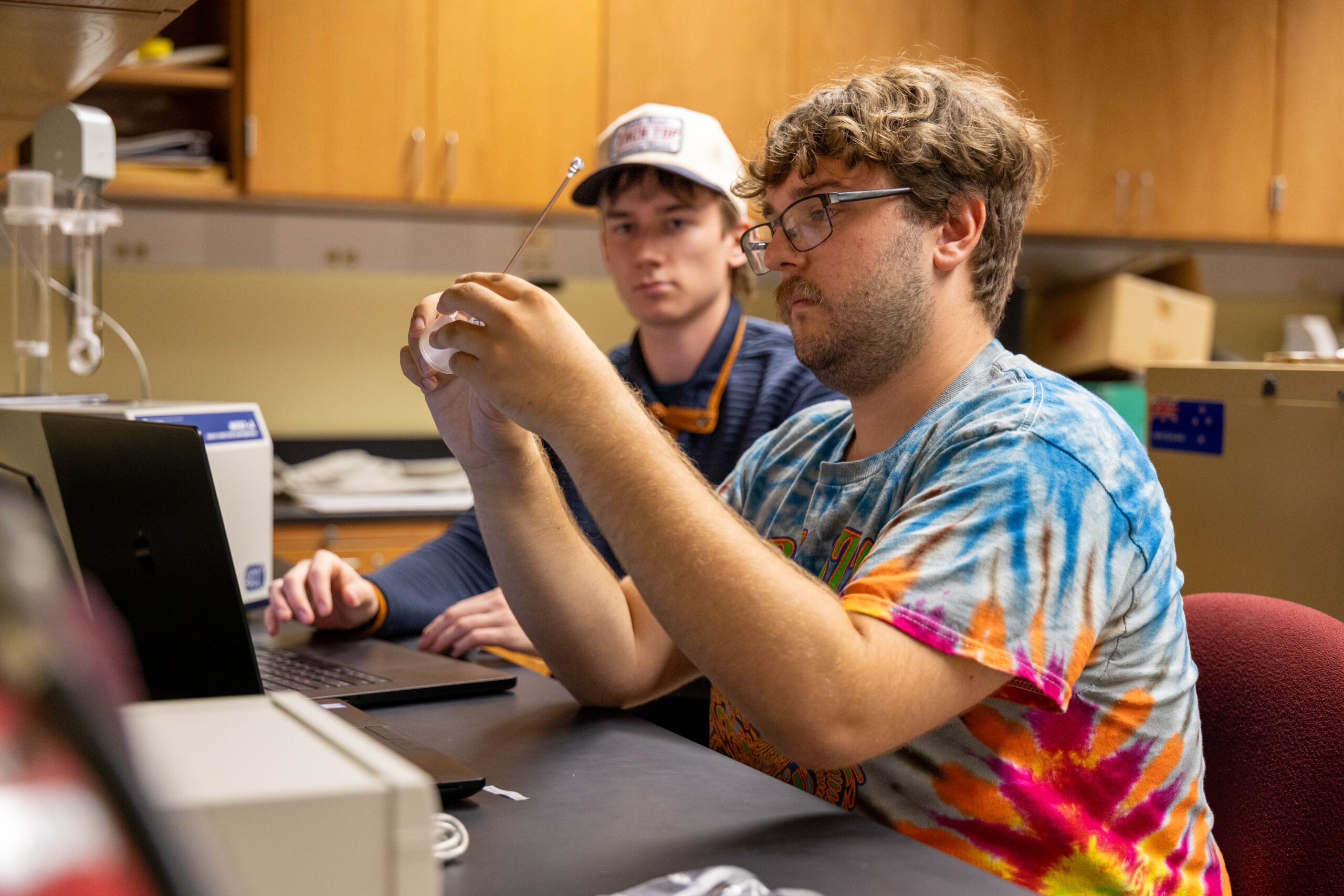
Jamie McCarthy ’27, right, measures magnetic susceptibility of black shale samples, with Ryan Britt ’27. (SUNY Geneseo/Mat Johnson)
This summer, Distinguished Professor of Geological, Environmental, and Planetary Sciences D. Jeffrey Over, PhD, and student researchers used a multi-year National Science Foundation (NSF) grant to study fossils and geochemistry to better understand two mass extinctions that occurred more than 350 million years ago.
Over and three students visited drill core storage facilities in Alabama and Ohio to study black shales from the Devonian Period that contain conodonts—the phosphatic tooth-like remains of an extinct marine organism commonly used to date rocks, and measure geochemical parameters to determine the depositional environment. The team also drilled five-meter-long cores of shale in similar age rocks from western New York and Canada, taking samples every centimeter. The students then studied a total of more than 300 fossils and the core material in campus labs.
Geology major Jamie McCarthy ’27 measured the magnetic susceptibility of the core material, which records the concentration of iron-bearing minerals in samples, a proxy for climate control of sea level change “which tells us where the rock was deposited and if it was closer to shore or offshore,” he said. “We are applying what we learn in class to real-world problems and processes.”
Ryan Britt ’27, also a geology major, used coding software to analyze the mineral data content and determine the time it took for the shale to form. Geochemistry major Jade Tankersley ’28 scanned and photographed conodont fossils with a high-powered microscope.
“You can fit many conodonts on the head of a pin,” said Tankersley. “The microscope lets us see individual cells, which lets us identify specific types of conodonts.”
The three students presented their research results in October at the Geological Society of America Annual Meeting in Denver, CO. Tankersly presented her talk in a session dedicated to conodont studies; Britt and McCarthy presented their posters in an integrated stratigraphy session.
Their research is part of an $860K collaborative project in which Over and a team of researchers from other institutions are studying how biogeochemical changes and Late Devonian extinction events (approximately 370 and 360 million years ago) shaped modern-day ecosystems. Over’s $105K NSF grant includes stipends for students, whose research will help the project team build a new geologic database and better determine what climate cycles looked like in that time frame.
“Work in the field and laboratory is the best way for students to experience and learn the techniques and skills needed to be a scientist,” said Over. “When the students have ownership of a project, it is even better, as they have a greater investment in the outcome and need to have an in-depth background of the topic being studied, which is why all projects have the goal of being published. Since the answer is never known in advance, the whole process is very exciting.”
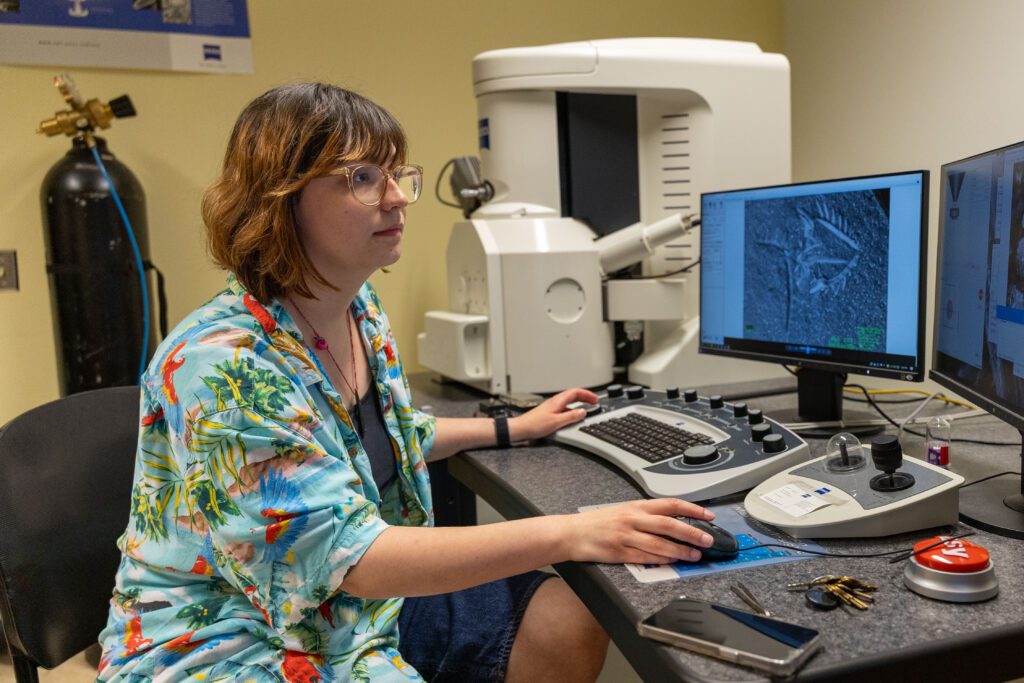
Jade Tankersley ’28 uses a high-powered microscope to inspect conodont fossils. (SUNY Geneseo/Mat Johnson)
Author
Kris Dreessen
Lead content writer
585-245-5520
dreessen@geneseo.edu
More Stories
UPD Lt. Phelps Completes FBI Program
Biology Professor Earns $228K Grant for STEM Teaching

Education Professor Awarded Grant to Advance STEM Learning Through Bike Engineering and Design
Amy Sheldon ’90 Named Associate Provost for Academic Affairs
SUNY Geneseo Highlights Student Experiences in ACE Program at College Council Luncheon
Princeton Review Again Names SUNY Geneseo a Best Value College

Distinguished History Professor’s Book Explores 500-Year History of Onondaga Nation