

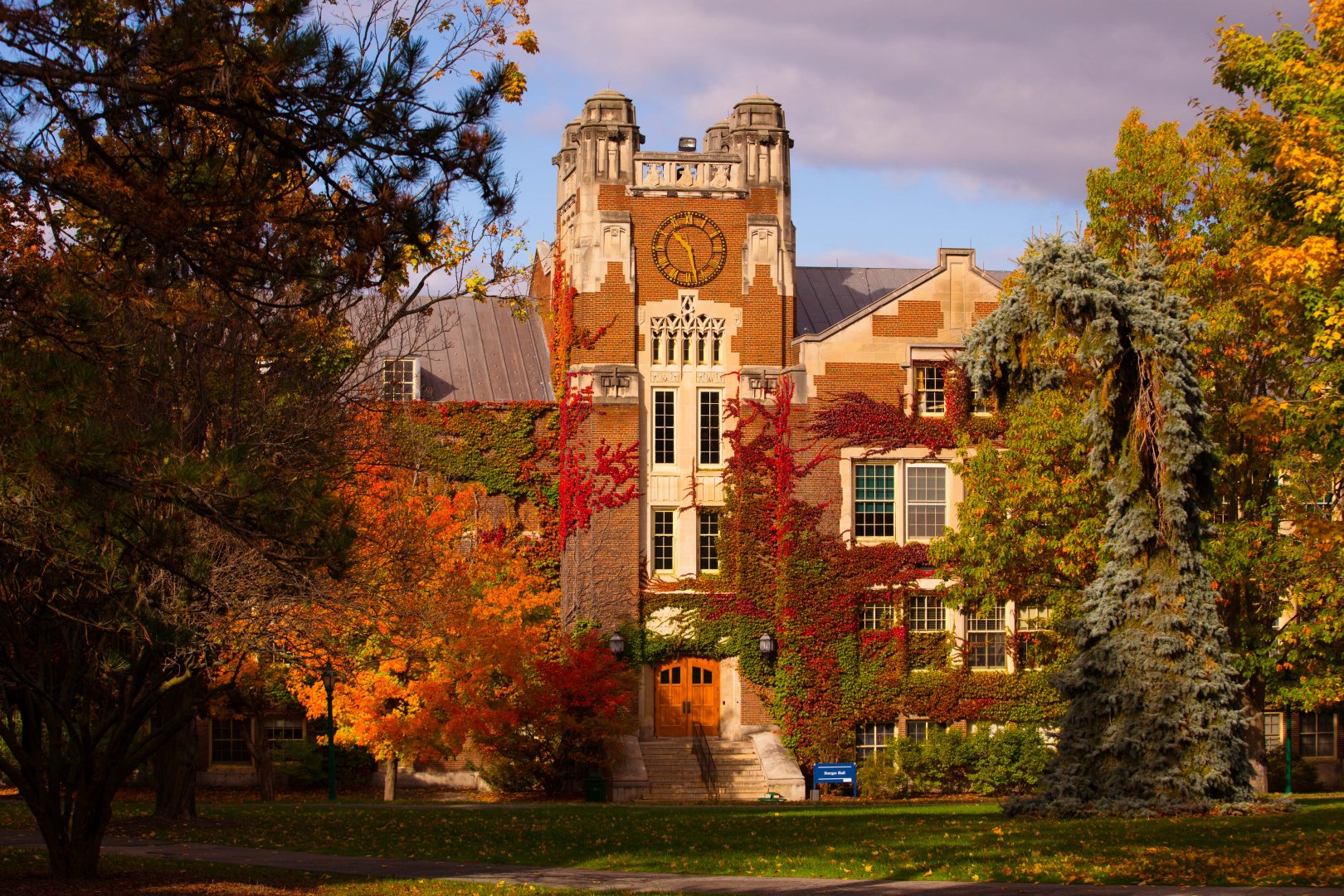
Sturges Hall (Photo by Keith Walters ’11)
Opinion
By Costas Solomou, Vice President, Enrollment Management
Published by the Office of Enrollment Management
When Yale University released its Committee on Trust in Higher Education report last week, the coverage was everywhere. A $94,000-a-year price tag. An acceptance rate below 4 percent. A rare moment of public self-reflection from one of the most well-known universities in the world. The New York Times covered it. So did The Washington Post, Fortune, and dozens of others.
Of course, I read it and I kept thinking: why are we having this conversation again, but this time Yale?
I work at SUNY Geneseo — New York’s Public Honors College — and what rarely gets said in these national discussions is this: the colleges that dominate the headlines are not the colleges that most students attend. When we keep the conversation focused only on Yale, Harvard, and their peers, we ignore the millions of students and families for whom an excellent, affordable education is not a fantasy. It is already a reality, at institutions like ours.
To its credit, the Yale report is honest. It admits that the way elite schools handle tuition and financial aid is confusing and hard for families to understand, and that this has hurt public trust. It acknowledges that wealthy applicants are more likely to get in than equally qualified middle-class students. And it notes that nearly half of Americans don’t even believe that generous financial aid at elite schools exists.
These are real problems specific to a small group of elite private colleges that collectively enroll a small percentage of undergraduates. Yale admits roughly 2,300 students a year. SUNY’s 64-campus system serves nearly 400,000. The University of California system, the California State system, the City University of New York — these are the institutions actually educating America’s workforce, actually moving first-generation students into the middle class, actually delivering on higher education’s democratic promise.
When the media focuses almost entirely on elite private universities, it gives the public a skewed picture of what college really costs and who it serves. That has real consequences. It creates cynicism. It discourages first-generation students from even applying. And it takes pressure off the policymakers who have been cutting funding to public higher education for years.
What “Affordable and Excellent” Actually Looks Like
I want to share what higher education actually looks like at SUNY Geneseo, because it is a story that should be told over and over again.
In-state tuition and fees run about $9,000 a year. Total cost of attendance for a New York resident — including housing and meals — is approximately $24,961. Through New York’s Excelsior Scholarship, eligible residents can attend tuition-free. The average net price for students receiving federal financial aid is under $19,000. Compare that to Yale’s $94,425 annual cost of attendance, and the difference speaks for itself.
But here is what I really want people to understand: this is not a discount education. U.S. News & World Report ranks Geneseo #1 in the nation for undergraduate teaching among regional universities. Washington Monthly ranks us #1 out of more than 600 master’s universities for contributions to the public good. We are one of only 293 four-year colleges in the entire country with a chapter of Phi Beta Kappa — the nation’s oldest and most prestigious academic honor society. Students who choose Geneseo regularly turn down offers from well-known private colleges because they understand they will receive a first-rate education at a fraction of the cost.
More than 22 percent of our students are the first in their family to attend college. As a first-generation student, I am incredibly proud of our commitment to first-generation students and families. We are serving the students that elite institutions spend their reports lamenting they cannot reach. And we are doing it without legacy preferences, without recruiting athletes who have no academic peer among their classmates, and without the opacity that the Yale committee rightly criticizes.
Selective, Inclusive, and Equity-Centered — All Three
One of the persistent myths in conversations about higher education access is that “selectivity” and “equity” are in tension — that you can have academic standards or broad access, but not both. This is a myth. Geneseo and many others are proof that this is a false choice.
We maintain high academic standards. We attract driven, talented students who want a rigorous liberal arts education. And we do it while ensuring that family income is not the deciding factor in whether a student can attend. The median federal loan debt for Geneseo graduates is $19,500 — a number students can realistically manage on an early-career salary, not the crushing burden that defines so many cautionary tales about student debt.
This is what equity-centered education actually looks like. It is not a slogan. It is a tuition rate, a scholarship program, a first-generation student support office, and a faculty committed to teaching and mentoring every student who walks through our doors. It is a daily commitment that says: your zip code and your parents’ income do not determine your future.
The Story We Should Be Telling
I am not dismissing the Yale report. When powerful institutions examine themselves honestly, that is a good thing, and its recommendations — on transparency, admissions equity, and cost — are worth pursuing. But I am asking the media, and the public, to look beyond the well-known names when telling the story of American higher education.
The bigger story is not Yale working to regain trust. It is the hundreds of public colleges and universities across this country that never lost it — because they never walked away from their core mission: to serve students from all backgrounds, at a price families can actually afford, and with an education that prepares graduates for real careers and meaningful lives.
SUNY Geneseo is one of those institutions. So are dozens of other SUNY campuses, and hundreds of public colleges in every state in this country. We are not famous. We do not make national headlines. But we show up every day for our students.
But we are educating America. And it is past time for that story to be told.
More Geneseo Stories
Princeton Review Again Names SUNY Geneseo a Best Value College
Distinguished History Professor’s Book Explores 500-Year History of Onondaga Nation
Geneseo Faculty and Staff Help Shape SUNY’s Response to Defining Challenges
SUNY Geneseo Earns Top-Five National Ranking from US News & World Report
SUNY Geneseo Partners with UR’s School of Nursing for Accelerated Degree Programs