

From The Depths
Rochester Fringe Festival @ Memorial Art Gallery
Friday 18th-Sunday 20th September
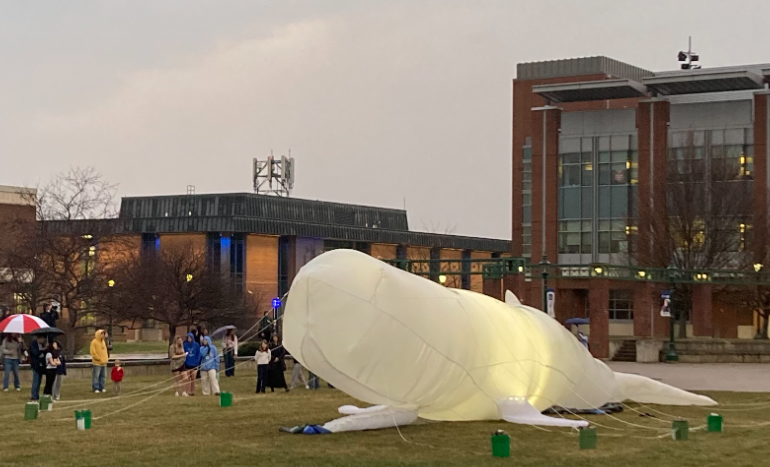
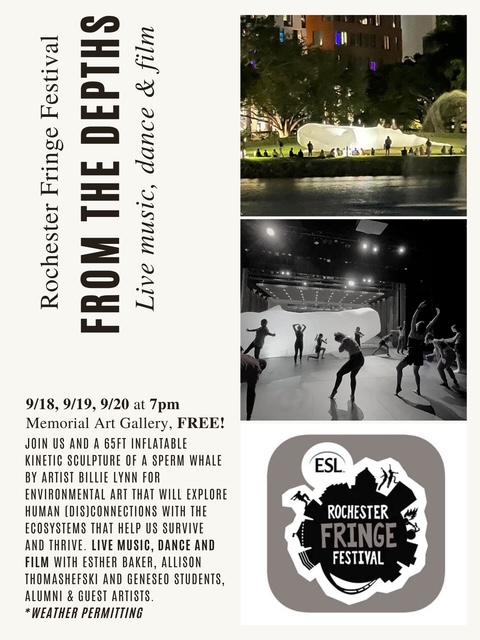
SUNY Geneseo and its collaborators are bringing their art-meets-science events focused around artist Billie Lynn’s kinetic sculpture, a 65-foot inflatable replica of a sperm whale, created to spark environmental conversations and help us consider the role of art in ecological awareness. Planned events include a cello performance from inside the whale; site-specific dance; and curated opportunities for attendees to enter the whale. Combining live performance and curated exhibition, this event will allow attendees to learn about whale acoustics and leave both transformed by a range of art disciplines and enriched by scientific knowledge.
Lynn’s sculpture will be on view from 3pm-9pm with a performance each day at 7pm
Performance Program
- 7pm: “Gentle Giant” Site-specific Dance Performance, choreographed by Allison Thomashefski ’11, in collaboration with dancers. Dancers: Hailey Adams ’29, LauRen Nicole Alaimo ’11, Natalia Biehl-narvaez, ’26 Casey Dapshi ’27, Aviva Daniel ’27, Kaitlyn Eck ’23, Madeline Dembowski, UB MFA Dance ’27, Eduardo Imbert ’27, Sydney Mahaney ’29, Cadence Panol ’26, Violet Rand ’27, Kayla Shaw ’27, Sarah Starr ’27, Allison Thomashefski ’11, Kelsey Wegman, UB BFA Dance ’22, Addison Wendt ’28
- 7.15pm: Literary readings featuring Albert Abonado (Sunday), Elizabeth Johnston Ambrose (Friday), JR Fenn (Saturday), Willa Carroll (Friday), Alicia Hoffman (Saturday), Tony Leuzzi (Sunday), Lytton Smith (Friday), and Stephen West (Saturday)
- 7.30pm: From the Depths cello performance by Esther Rogers Baker
- 8.00pm: Ecopoem Film Screenings, featuring Willa Carroll and Jonathan Everitt
- 8.25pm: “From the Depths a Light” Dance performance, from inside the whale. I. from the deeps; II. funky bubbles; III. loneliness/solitude. Improvisation by Allison Thomashefski, in collaboration with Esther Rogers Baker and Geneseo students: Willow Bertram, Maggie Brchnel, Jasmine Buffone, Ace Bodkin, Thatcher Kaye, Mykayla McCarthy, Tavoris Parilla-Rozier. *Special thanks to Reilly Spitzfaden and Gene Baker.
All movement was created through an exploration of each dancer’s reaction to engaging with this unique site, its meanings, its shape, its movements, and its energy.
Artist Statement: Billie Grace Lynn, Have Whale Will Travel
This has always been the work of art: to inspire the senses — to make the body feel — without necessarily direct experience, through signs, colors, sounds, movement, and so on. At its highest, the experience and the making of art are identical.
Accordingly, my work is usually interactive and kinetic in nature. I strive to make pieces in which the viewer interface is both the form and function of the piece. I want people to remember themselves, in much the same way that babies discover their fingers. When my work is successful, the piece is completed by the viewer-participant and she/he continues her/his journey more aware and delighted in being a body.
Sperm Whale
The sperm whale is the inspiration for artist Billie Lynn’s 65-foot inflatable sculpture. The sculpture may be light, but a sperm whale this size weighs more than 60 tons, about half the combined weight of the SUNY Geneseo graduating class of 2026.
Where does the name come from? While hunting, whalers found gallons of a waxy substance in the whale’s heads, known as spermaceti. But spermaceti has nothing to do with reproduction; this oil sac helps sperm whales focus sound. Sperm whales communicate and locate food with clicks, making a characteristic call that can be heard for hundreds of miles. When hunting, sperm whales routinely dive to depths of 2000 feet and greater, holding their breath for more than 45 minutes!
Between 1800 and 1987, commercial whaling killed hundreds of thousands of sperm whales, decimating these populations. People hunted these whales to use spermaceti in oil lamps, lubricants, and candles until the 1986 moratorium on commercial whaling. Today, sperm whale populations are thought to be recovering, but these and other marine mammals remained threatened by vessel strikes, entanglement in fishing gear, ocean noise, marine debris, and climate change. By learning more about our amazing neighbors and our impact on nature, we can make better decisions to protect these species for generations to come.
Read more about sperm whales in this resource from NOAA. Join us at the whale to learn more and to make your own climate action plan (h/t to Dr. Ayana Elizabeth Johnson)!
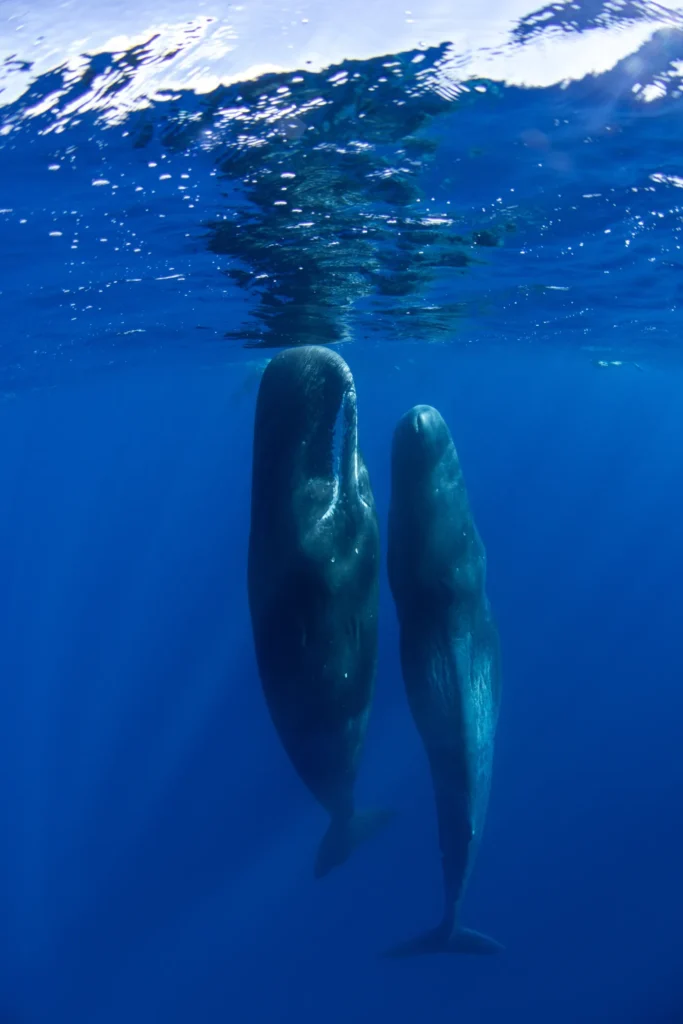
Physeter macrocephalus. Did you know that sperm whales sleep vertically? Photo by WWF Australia.
Listen to Whales – Bioacoustic Monitoring
Ocean Song offers open bioacoustic monitoring, via “A distributed network of underwater microphones, monitored continuously by machine learning. Detecting whale vocalizations as they happen, across two oceans.”
Reader Bios
Albert Abonado is a poet and essayist based in Rochester, NY. He is the author of JAW (Sundress Publications 2020) and Field Guide for Accidents (Beacon 2024), a National Poetry Series selection. He holds an MFA from the Bennington Writing Seminars. He has received fellowships for poetry from the New York Foundation for the Arts and the National Endowment for the Arts.
Elizabeth Johnston Ambrose (she/her) is the author of Wild Things, (Main Street Rag, 2021) and Imago, Dei (winner, Rattle Chapbook Poetry Prize, 2022). Her writing appears or is forthcoming in The Atlantic, The Sun, McSweeney’s, Lunch Ticket, Verse Daily, and The Massachusetts Review, among others. Awarded the 2025 Betsy Colquitt Poetry Prize, Elizabeth teaches writing and gender studies in Rochester, NY where she also leads trauma-writing workshops at the Breast Cancer Coalition and serves on the board of Just Poets. www.elizabethjohnstonambrose.com, Bluesky @poetlady74, Instagram at johnstonlibby74
Willa Carroll is a writer and interdisciplinary artist. Her debut full-length poetry collection, Nerve Chorus (The Word Works), was noted in The Common as a “meticulously choreographed treatment of life as art.” Carroll’s poems have appeared in AGNI, Poem-A-Day, Tin House, The Slowdown and elsewhere. She won Narrative Magazine’s Third Annual Poetry Contest and Tupelo Quarterly’s TQ7 Poetry Prize, judged by Brenda Hillman. Her chapbook, Demolition Suite, was a finalist for the Tomaž Šalamun Prize and selected for the Split Rock Press Chapbook Series. Her poetry videos and multimedia collaborations have been featured in Interim Poetics, Narrative Outloud, TriQuarterly and elsewhere. Twice awarded Best Poetry Film at the International Migration and Environment Film Festival, her work has been featured at festivals in seven countries. Carroll has collaborated with numerous artists, musicians, dancers, and performers. After earning degrees from Bennington and living in NYC for twenty-five years, she’s currently based in upstate, NY.
Jonathan Everitt’s poetry has appeared or is forthcoming in Laurel Review, BlazeVox, Scarlet Leaf Review, Small Orange, Impossible Archetype, Ghost City Press, The Bees Are Dead, The Empty Closet, Lake Affect, and the Moving Images poetry anthology, among others. Jonathan earned his MFA in creative writing from Bennington College. He lives in Rochester, N.Y.
JR Fenn is the author of the fiction chapbook Tiny Vessels (2026), winner of The Masters Review Chapbook Open. Her writing has appeared or is forthcoming in many places, including Boston Review, The Georgia Review, DIAGRAM, Split Lip, and Witness. Recognitions include the New Millennium Award for Flash Fiction, Stone Canoe’s Robert Colley Prize, and the Gulf Coast Prize for Nonfiction. Her work has been supported by Ucross, Hewnoaks, Orion, the Key West Literary Seminar, and more. She teaches Fiction and Environmental Writing at SUNY ESF. www.jrfenn.com. @jr.fenn (IG) // @jess.fenn.37 (FB) // @jrfenn.bsky.social (BSKY).Originally from Pennsylvania, Alicia Hoffman now lives, writes, and teaches in Rochester, New York. A graduate of St. John Fisher College, she received her MA from SUNY Brockport and her MFA at the Rainier Writing Workshop in Tacoma, Washington. Her poems have appeared in a variety of publications, including Thrush, Radar Poetry, Tar River Poetry, The Penn Review, The Shore, Glass: A Poetry Journal, and elsewhere. Her most recent collection, Browsing as a Guest (Gnashing Teeth Publishing), interrogates the intersection between humanity and technology in the modern world.
Tony Leuzzi is a poet, critic, and art maker whose most recent book of poems, Fog Notes (Tiger Bark 2023), was a finalist for the 2023 Big Other Book Award for Poetry. Passwords Primeval (BOA Editions 2012) is a collection of his interviews with 20 American poets. Leuzzi has received several teaching awards, including the Wesley T. Hansen Award, and is the recipient of the State University of New York’s Chancellor’s Award for Scholarship and Creativity. His interviews and criticism have been published in Lambda Literary, SCOUT Poetry, American Literary Review, Great River Review, The Kenyon Review (Online), The Poetry Society of America, and—most frequently—The Brooklyn Rail. A self-taught artist, Leuzzi’s images on paper and on board incorporate erasure, and collage.
Stephen J. West is the author of Soft-Boiled: An Investigation of Masculinity & The Writer’s Life (Kelson Books). His essays have appeared in Brevity, Bridge Eight, Fugue, PANK, and Zone 3, among others, and he was a Featured Artist in Ninth Letter who published his artist’s book, DIY View-Master: Intimate Space. Stephen is the creator and curator of Undead Darlings, a literary and art project that celebrates the traces that artmaking leaves behind. He teaches Creative Writing at St. John Fisher University in Rochester, NY. Undeaddarlings.com + IG @undead.darlings + @stephenjwest_future