

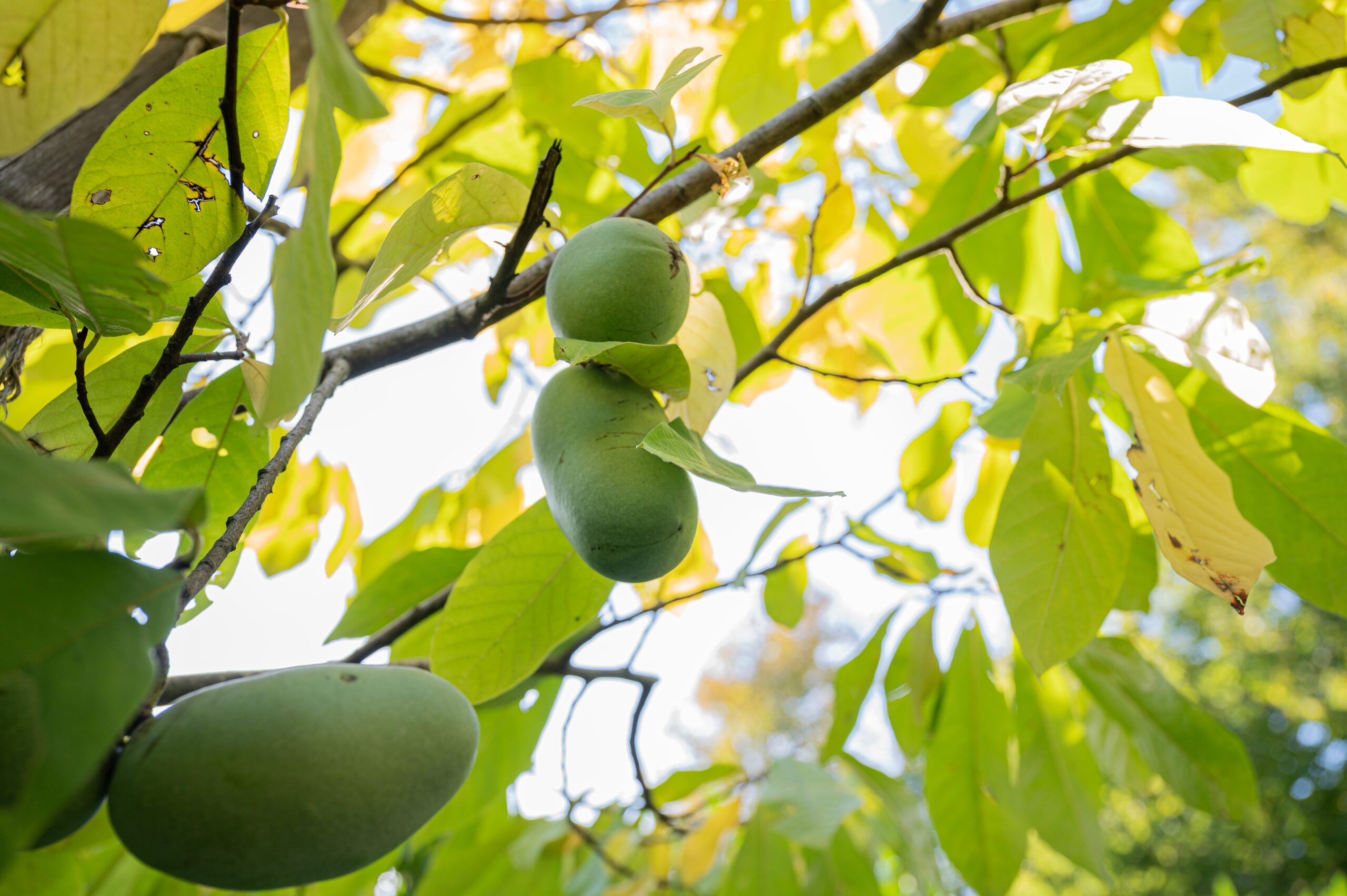
Pawpaws (Gajus-Images via Envato)
Article title
Pawpaw proliferation: Significant increases in the pawpaw tree (Asimina triloba [L.] Dunal) across the eastern United States in the early 21st century
Summary
Pawpaw, an understory tree species in eastern North America noted for having the largest native edible fruit on the continent, is increasing according to various measures across its geographic range.
Abstract
The pawpaw (Asimina triloba [L.] Dunal) is an understory tree with diverse ecological functions and potential as a horticultural product. Due to toxicity in its leaves and bark that make it unpalatable to deer, it thrives in forests where browsing decreases other tree species, and where its ability to attenuate light suppresses other seedlings. However, its future under climate change remains unclear, as change may have opposing influences upon its success. This study examined early 21st-century trends in pawpaw abundance, dominance, and frequency in the eastern US. Utilizing the Forest Inventory and Analysis database, this study characterized trends across eight metrics for the entire eastern US, within EPA-defined ecoregions, and within select states. The study found that pawpaw was significantly increasing (often p < 0.001) across most metrics, within most ecoregions, and within states examined. For instance, estimates from 2010 to 2021 for pawpaw seedlings (i.e., <2.54 cm DBH) increased from 60.7 (±4.3) to 74.5 (±4.7) stems ha-1 of forestland, and trees increased from 3.6 (±0.5) to 4.6 (±0.6) stems ha-1 of forestland, within a region covering 30 states. Increases were greater in some ecoregions, and occurred in many ecoregions where pawpaw was most common. The tree comprised an increasingly higher percentage of total stems and basal area. Overall, pawpaw is increasing at a continental scale likely from the combined effects of preferential deer browsing, pests or pathogens afflicting neighboring tree species, fire suppression, and a warming climate. Landowners and managers should weigh the pros and cons of pawpaw expansion.
Main research question
What has been the 21st-century trajectory of pawpaw in eastern North America – is it increasing or decreasing according to forest metrics (like relative abundance, relative dominance, and relative importance)?
What was already known
Pawpaw is resistant to deer browsing, grows in similar habitats as ash trees, is fire sensitive, and could benefit at its northern range limits from increasing temperatures – all of which could benefit the species in the late 20th and early 21st centuries. Currently forests are subjected to deer overbrowsing, ash dieback, fire exclusion, and climate change.
What the research adds to the discussion?
It shows that pawpaw is almost uniformly increasing across eastern North American according to various measures – potentially due to the combined effects of preferential deer browsing, ash dieback from emerald ash borer, fire suppression, and climate change.
Implications for society
Pawpaw is increasing across its geographic range. This increase has ecological and economic implications. Its ability to form dense clonal thickets and “crowd out” other tree species (that are also economically valuable) means that pawpaw may make forests less structurally diverse and less economically valuable as timberland. On the other hand, pawpaw is noted for having the largest native edible fruit on the continent, and some landowners may wish to encourage its growth.
Implications for research
Future research may investigate the exact mechanisms of pawpaw increases—whether it is ash dieback, increasing temperatures, deer browsing, or fire suppression.
Implications for policy
If economic production of timber is preferred, active management may be required to suppress the growth of pawpaw and encourage the growth of other more merchantable tree species.
Citation:
Tulowiecki, SJ. Pawpaw proliferation: Significant increases in the pawpaw tree (Asimina
triloba [L.] Dunal) across the eastern United States in the early 21st century. Forest Ecology and Management 604: 123500.
More Research Briefs
Call for Research
We invite SUNY Geneseo faculty to submit peer-reviewed research from the last three years to be added to this site.