

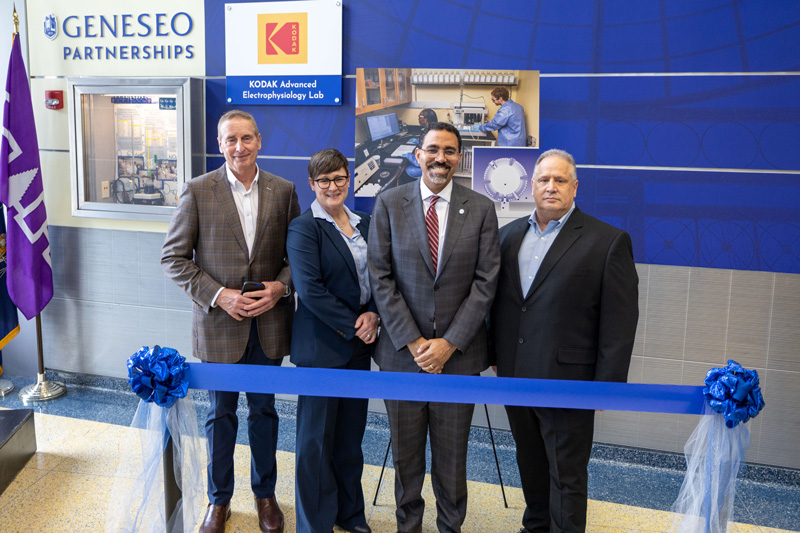
L to R: SUNY Trustee Bob Duffy, Geneseo President Melinda Treadwell, SUNY Chancellor John B. King Jr., Kodak Executive Chairman and CEO Jim Continenza (SUNY Geneseo photo)
SUNY Geneseo celebrated the opening of its new Kodak Advanced Electrophysiology Lab (AEPL) with a ribbon-cutting in the Integrated Science Center on April 23. The lab is the result of a partnership with Eastman Kodak’s Pharmaceuticals unit, whose gift of $625K to The Geneseo Foundation, Inc., funded the equipment to establish the lab.
“We are grateful for the partnership created through the Kodak Advanced Electrophysiology Lab at Geneseo,” says SUNY Geneseo President Melinda Treadwell. “This innovative and flexible laboratory is a physical manifestation of the exceptional work SUNY Geneseo and our corporate partners are doing to support research and development, create applied learning experiences for every Geneseo student, and build a pipeline of talented graduates ready to address regional workforce needs in biotechnology. Together, we are creating solutions and demonstrating what an undergraduate collegiate honors college experience should be.”
The opening event was attended by Kodak Executive Chairman and CEO Jim Continenza; SUNY Trustee Bob Duffy; SUNY Chancellor John B. King Jr.; SUNY Senior Vice Chancellor for Operations and Management and Chief Operating Officer Anne Bink; SUNY Senior Vice Chancellor for Academic Affairs Julie Hartley-Moore; SUNY Director of Government Affairs Maria Volpe McDermott; NYS Senator Pam Helming; NYS Assemblymember Andrea Bailey; and Geneseo College Council Chair Christian Valentino.
“The opening of the Kodak Advanced Electrophysiology Lab (AEPL) is the beginning of a valuable partnership for Kodak and SUNY Geneseo,” says Jim Continenza, Kodak’s executive chairman and CEO. “The lab will help support our growing pharmaceutical business by evaluating the performance of our products in biological and clinical settings and provide insights about real-world customer requirements. In addition, SUNY Geneseo will be an important source of scientific talent we’ll need to sustain future growth of our pharmaceutical business in the United States.”
“SUNY is leading the way in forging unique partnerships that help our students and faculty conduct cutting-edge research,” says SUNY Chancellor King.“The work being done at SUNY Geneseo’s Kodak Advanced Electrophysiology Lab will help improve the lives, safety, and health of all New Yorkers. We are proud of our researchers throughout New York State as they work to achieve cutting-edge breakthroughs for the public good, and I commend them for ensuring SUNY remains at the forefront of innovative research and scholarship.”
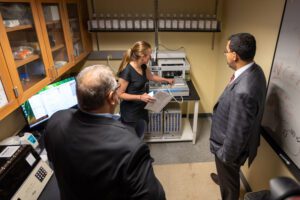
to Continenza (L) and King
(SUNY Geneseo photo)
Electrophysiology
The field of electrophysiology examines how electrical signals are generated and carried by cells, explains Tara Sweet, assistant professor of biology–psychology and the lead scientist with oversight for the lab. It focuses on how ions move across cell membranes and the proteins that act as doorways, or channels, to make that happen. “Moving ions does all kinds of important things in your body, but without their movement you wouldn’t be able think, move, or even live. We are particularly interested in how ions moving influences water movement and cell volume and shape.”
The new lab features both automated and manual equipment called “patch clamp systems,” which is the technology used to measure the ionic currents of cells. The eight ports in the automated system are flexible enough to make it suitable for both academic research and drug discovery and testing in pharma and biotech.
“One of the ways we will use the technology is to better understand an ion channel that is important for gastrointestinal system movement and is known as important in cancer cell division and migration,” Sweet says.
Research Opportunities
The lab is about more than new equipment, says Agya Boakye-Boaten, dean of Geneseo’s School of Arts and Sciences. “It is designed to give our students hands-on, state-of-the-art experience, helping to prepare them to become the next generation of scientific leaders and innovators. We are eager to see the groundbreaking research this lab will inspire and the collaborative opportunities it will create for our faculty and the wider scientific community.”
Geneseo’s biology, biochemistry, chemistry, and neuroscience majors will gain a competitive edge from access to the lab’s automated patch clamp system, technology not usually found in undergraduate laboratories. Among other skills, students will get hands-on training in electrophysiology, cell culture, and making solutions. These are particularly valuable skills for neuroscience majors.
The dual capabilities of the automated and manual systems open opportunities for collaborations with outside scientists as well as Geneseo faculty and students. The College anticipates lab use by outside researchers from neighboring colleges and universities, independent labs, and national collaborators.
The Kodak AEPL equipment and the skills required to use it intersect with Kodak’s products and research needs. Experiments in the lab will use solutions and chemicals from Kodak, and the lab will be used to test and validate pre-market or beta-stage products developed by Kodak or in collaboration with Kodak R&D teams. Geneseo also plans to create a working group of electrophysiologists, neuroscientists, and biologists who can provide feedback on evolving research needs, product preferences, and product development insights.
Author
Robyn Rime
Senior Writer and Editor
585-245-5529
rime@geneseo.edu