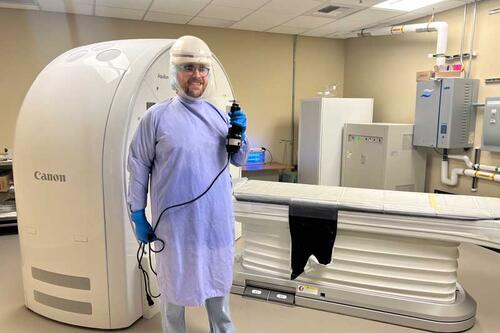
Hunter Kane '16 (photo provided).
As a forensic autopsy technician in the King County, WA, Medical Examiner’s Office, Hunter Kane ’16, MA, spends each day with the deceased.
“Autopsy technicians are the first set of eyes for the pathologist,” Kane explains. “I see if a body presents anything anatomically unique or pathologically significant.” His responsibilities aren’t for the timid: opening the body, removing the organs, collecting bodily fluids and tissue samples.
Kane didn’t set out to autopsy bodies—he started by falling in love with primatology. An anthropology major at Geneseo, he took courses from associate professor emerita Barbara Welker, who was known locally for her forensic expertise. After graduating, he earned a master’s degree in physical and biological anthropology from the University at Buffalo, “a beautiful blend of social science and science.”
Studying anatomy
Encountering his first human anatomy cadaver while in graduate school was revelatory for Kane—mostly because he didn’t find it scary. To be honest, he says, “I had this weird warm feeling, realizing how much I could learn from that person.” The experience convinced him he had found his calling.
Serving the deceased fascinates Kane.
“I’m on my toes at all times because every day is vastly different than the last,” he says. “You never know what you’re going to see inside of a person. The beauty in this is that I get to see so many different types of anatomy every day.”
Helping solve crimes
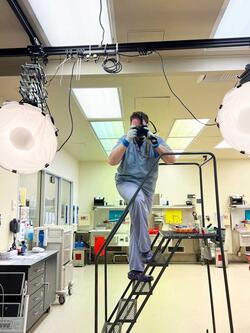
Most cases through the King County ME’s office are natural or accidental deaths. Occasionally, however, a person’s manner of death is suspicious.
“Every time we have a suspected homicide or suspected undetermined death, we always stay attuned to the decedent and let them ‘speak’,” says Kane. “What is the decedent telling me? How can I make sure they get justice if a crime was involved?”
Kane regularly assists law enforcement with criminal investigations by collecting, photographing, and documenting evidence for homicide cases. One challenge in that process is what forensic specialists call the CSI effect, where jurors believe medicolegal labs can accomplish the same extraordinary feats seen on television. That’s misleading, says Kane. Real-life technicians can achieve less than their fictional counterparts, but their work is critical when cases go to trial.
“It feels good to be a part of that chain of custody,” Kane says. “I feel like I make a difference in solving those cases.”
Being a “last responder”
A firm belief in the importance of what he does helps ground Kane during the days when being a “last responder” is difficult. What forensic autopsy technicians do is not seen by the public, not talked about in the media. COVID was awful, he says; fentanyl continues to be awful. The job, with its constant exposure to trauma, is mentally and physically taxing.
Nevertheless, Kane says, he loves doing what he does. He believes he’s making a difference in his community, and he demonstrates deep respect for those in his lab, both the living and the dead.
“I treat each case as if it’s of the utmost importance, so we can figure out what happened to this person,” he says. “I’m very thankful for my team on those days when I have to take a step away. I’m grateful for the next of kin who thank me for being so kind to their loved one during a terrible experience.”
And he’s grateful for his alma mater. “I wouldn’t be doing this job if I hadn’t gone to Geneseo and taken that general education course in anthropology,” Kane says. “I’m so thankful for Geneseo showing me what I could do.”
Learn more about the Department of Anthropology.